Send Money From South Africa to Zimbabwe: Costs, Options and How the Corridor Works in 2026
Learn how to send money from South Africa to Zimbabwe, including transfer costs, bank transfers, mobile money, cash pickup, regulations and payout options.

On this page
Sending money from South Africa to Zimbabwe is one of the most important cross-border payment needs in Southern Africa.
The corridor is large, essential for many households and still expensive.
A joint IMF-World Bank diagnostic of the South Africa-Zimbabwe corridor found that Zimbabwe received nearly half of its remittances from the SADC region from South Africa in 2023. The report also found that remittances were equivalent to 9.6% of Zimbabwe's GDP and that the average cost of sending money through the corridor reached 12.7% in the first quarter of 2024.
More recent pricing data from the World Bank's Remittance Prices Worldwide programme showed that the average total cost of sending the equivalent of US$200 from South Africa to Zimbabwe was 12.49% in Q3 2025. The average cost for the US$500 sample was 8.48%.
That difference matters.
Smaller transfers can carry a much higher percentage cost. A person sending money regularly to support family in Zimbabwe can therefore lose a significant amount to fees and foreign-exchange margins over time.
South Africa to Zimbabwe corridor at a glance
- Nearly half: Zimbabwe received nearly half of its SADC-region remittances from South Africa in 2023, according to the IMF-World Bank South Africa-Zimbabwe Corridor Diagnostic Report.
- 9.6% of GDP: Remittances were equivalent to 9.6% of Zimbabwe's GDP, according to the IMF-World Bank Corridor Diagnostic PDF.
- 12.7% average cost: The corridor's average remittance cost reached 12.7% in Q1 2024, according to the IMF-World Bank Corridor Diagnostic.
- 12.49% for US$200: World Bank data for Q3 2025 recorded an average total cost of 12.49% for the US$200 transfer sample on the South Africa-to-Zimbabwe corridor.
- 8.48% for US$500: The average total cost fell to 8.48% for the US$500 transfer sample during the same World Bank collection period.
- 66% within one hour: The IMF-World Bank diagnostic reported that 66% of observed South Africa-to-Zimbabwe transfers in its Q1 2024 dataset were sent within one hour.
Why the South Africa to Zimbabwe corridor matters
South Africa is home to a large Zimbabwean diaspora.
That makes the movement of money between the two countries important to families and communities on both sides of the border.
The IMF-World Bank corridor diagnostic describes the route as a critical remittance channel within Southern Africa.
Zimbabwe's dependence on remittance income also gives the corridor wider economic importance.
Money sent from South Africa can help households pay for food, rent, education, healthcare and other day-to-day expenses.
For many senders, the transaction is not occasional.
It is repeated.
That makes the cost of each transfer especially important.
A difference of a few percentage points in the total cost can add up over a year.
How does sending money from South Africa to Zimbabwe work?
The process normally follows this route:
Sender pays in South African rand → Bank or money transfer provider processes the transaction → Required compliance checks are completed → Currency conversion and settlement take place → Funds enter the Zimbabwe payout network → Recipient receives the money
The exact process depends on the provider.
A bank may use correspondent banking relationships and its own cross-border payment infrastructure.
A money transfer operator may use separate settlement arrangements and local payout partners.
A digital provider may combine bank accounts, mobile money networks and other local payment infrastructure.
The recipient can usually receive the money through one of several methods, depending on the service.
These may include:
- A bank account
- A supported mobile money wallet
- Cash pickup
- Another local payout arrangement
The best method depends on what the recipient can actually access.
A bank transfer may not be the best choice for someone who needs immediate access to funds through a mobile wallet.
Cash pickup may be useful for one recipient but unnecessary for another who already uses a bank account.
Popular ways of sending money to Zimbabwe from South Africa
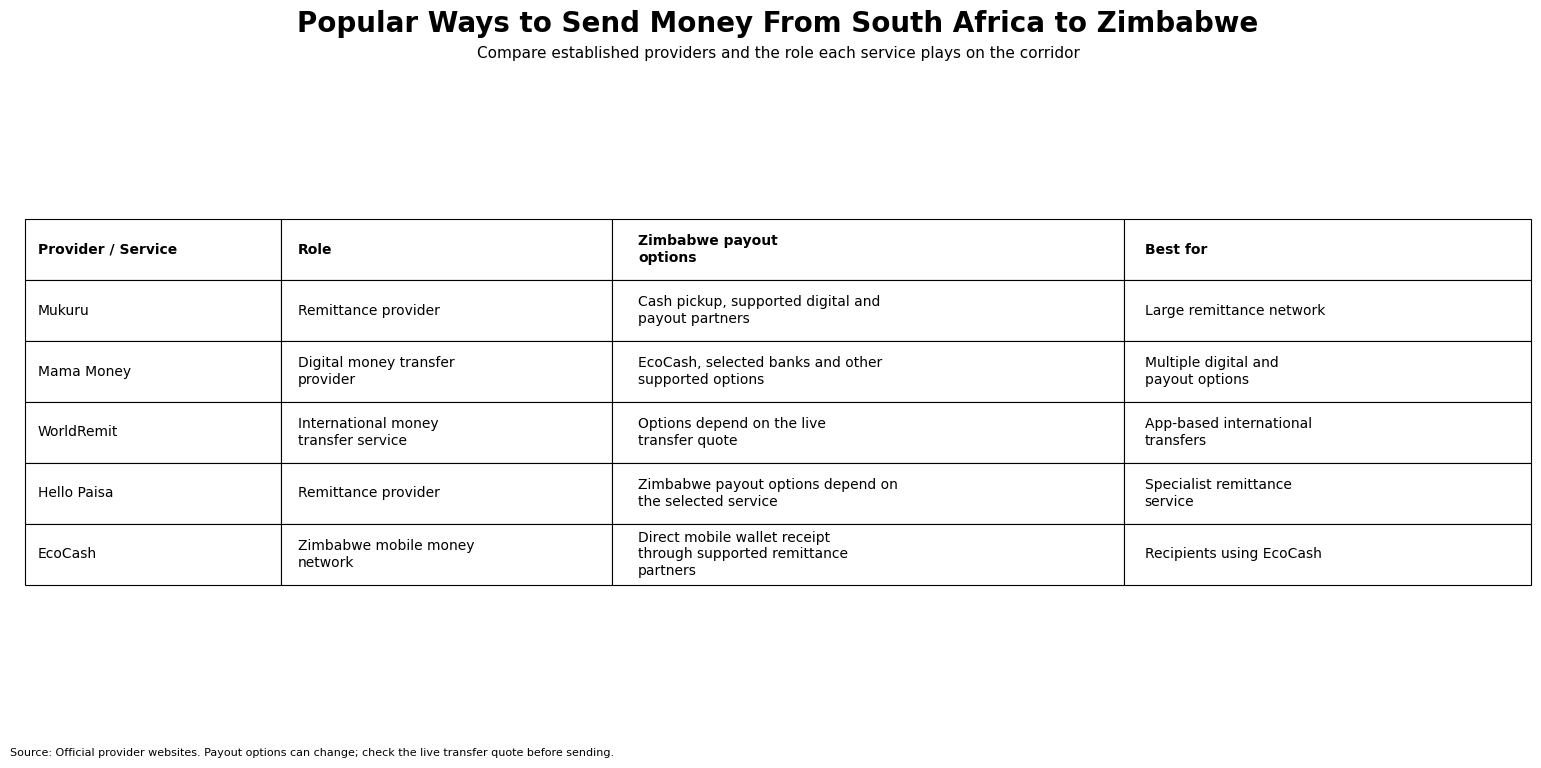
- The South Africa-to-Zimbabwe corridor offers several distinct transfer options. Mukuru, Mama Money, WorldRemit and Hello Paisa operate as money transfer providers, while EcoCash plays a different role as a major Zimbabwean mobile money network that can receive remittances through supported partners.
- Mukuru stands out for its established remittance network. Its combination of physical and digital payout arrangements can make it useful for recipients who need flexible access to funds.
- Mama Money focuses more heavily on digital transfers and multiple payout options. This can be particularly useful when the recipient prefers receiving money through a supported mobile wallet, bank account or other available digital channel.
- WorldRemit offers an app-based international transfer experience. However, the available payout options, exchange rates and fees should always be checked in the live quote before sending.
- Hello Paisa is another specialist provider serving the South Africa remittance market. Senders should compare its final payout and available Zimbabwe delivery options against other providers before choosing a service.
- EcoCash is best understood as a receiving rail rather than a direct replacement for every money transfer provider. For recipients who actively use EcoCash, supported remittance partners may provide a convenient way to receive money directly into a mobile wallet.
- The best provider depends on the recipient's needs. A sender should compare the transfer fee, exchange rate, final amount received, delivery time and available payout method rather than choosing a provider based on the advertised fee alone.
What does it cost to send money from South Africa to Zimbabwe?
There is no single cost.
The amount sent can make a significant difference.
The World Bank's Remittance Prices Worldwide data showed that the average total cost for the US$200 sample was 12.49% in Q3 2025.
The average total cost for the US$500 sample was lower at 8.48%.
The total cost can include more than the visible transfer fee.
The World Bank's methodology also considers the exchange-rate margin.
This is important because a provider can advertise a low transfer fee while applying a less favourable exchange rate.
For that reason, the transfer fee alone does not show the real cost.
The more useful question is:
How much money will the recipient actually receive?
Before confirming a transfer, compare the final payout as well as the advertised fee.
Why can the cost be so high?
The IMF-World Bank diagnostic identified several structural issues affecting the South Africa-to-Zimbabwe corridor.
These included heavy reliance on cash, limited access to formal financial services for some migrants, compliance and AML/CFT costs, operational challenges, limited competition and payment infrastructure gaps.
Cash is particularly important.
Cash handling creates additional costs.
Money may need to be collected, secured, transported and distributed through physical locations.
The diagnostic found that cash-related expenses represented a major part of the cost structure for remittance services operating in Zimbabwe's cash-heavy environment.
Compliance requirements can also add costs.
Cross-border providers must meet customer identification, transaction monitoring and other regulatory obligations.
These requirements are important for preventing financial crime.
However, they can create higher costs for smaller providers when systems and processes are inefficient.
The IMF and World Bank diagnostic recommended reforms including better interoperability, wider use of faster payment infrastructure, risk-based approaches to AML/CFT requirements and measures that could improve competition.
Sending money to a Zimbabwean bank account
A bank account transfer may be suitable when the recipient has an active account and wants the funds deposited directly.
The information required depends on the provider.
You may need details such as:
- The recipient's full legal name
- The bank name
- The account number
- Other banking information requested by the provider
Processing times can vary.
Some providers may offer faster settlement than traditional bank-to-bank routes.
The fees and exchange rates can also differ significantly.
Before sending, check the expected delivery time and the exact amount the recipient is expected to receive.
For a detailed rail-specific breakdown, see how to send money from South Africa to a bank account in Zimbabwe.
Sending money to mobile money in Zimbabwe
Mobile money can provide a convenient payout method when the recipient uses a supported wallet.
Availability depends on the provider's local partnerships and supported payout networks.
Before choosing this method, check:
- Which mobile wallet is supported
- Whether the recipient's wallet is active
- Whether the mobile number is correct
- Any transaction limits that apply
- The currency in which the money will be made available
- The final amount the recipient will receive
For a dedicated mobile money page, see how to send money from South Africa to EcoCash in Zimbabwe.
Sending money for cash pickup in Zimbabwe
Cash pickup can be useful when the recipient does not have access to a suitable bank account or mobile wallet.
The sender normally needs to choose a supported collection location through the provider.
Before sending, check:
- Available pickup locations
- Identification requirements
- Collection hours
- Transfer limits
- The expected payout currency
- The exact amount available for collection
The recipient should also make sure their identification details match the information submitted with the transfer.
Incorrect names or other details can delay collection.
For more information, see how to send money from South Africa for cash pickup in Zimbabwe.
South African rules for sending money abroad
Cross-border transfers from South Africa operate within the country's foreign-exchange and financial surveillance framework.
The South African Reserve Bank's Financial Surveillance Department is responsible for the administration of South Africa's exchange-control framework.
The SARB explains that members of the public generally deal with foreign-exchange transactions through Authorised Dealers and Authorised Dealers in foreign exchange with limited authority.
Depending on the transaction, a bank or payment provider may ask for information such as:
- Identification
- Sender details
- Recipient details
- The purpose of the payment
- Source-of-funds information where required
The exact requirements can vary depending on the amount, the type of transfer and the institution processing it.
Always check the current requirements with the regulated provider handling your transfer.
What currency will the recipient receive in Zimbabwe?
The answer depends on the provider and the payout method.
Zimbabwe's remittance and payments environment has a significant foreign-currency component.
The IMF-World Bank diagnostic highlighted the role of foreign currency and cash in the country's remittance environment.
The currency available through a specific transfer can depend on the provider's product and payout arrangements.
Before confirming the transfer, check:
- Which currency the recipient will receive
- Whether currency conversion will take place
- The exchange rate being applied
- The total fees
- The final amount the recipient will receive
Do not assume that paying in ZAR means the recipient will receive ZAR.
How long does it take to send money from South Africa to Zimbabwe?
Transfer times depend on the provider and payout method.
They can also be affected by compliance checks, banking hours, weekends, public holidays and the settlement arrangements used.
The IMF-World Bank diagnostic found that 66% of observed South Africa-to-Zimbabwe transfers in its Q1 2024 dataset were sent within one hour.
That does not mean every transfer reaches the recipient within one hour.
It shows that faster options are available in the corridor.
The actual delivery time can still vary significantly between providers.
Always check the expected delivery time before confirming a transfer.
How to compare South Africa to Zimbabwe money transfer providers
Do not compare providers using the fee alone.
Compare the complete transaction.
Check the transfer fee
This is the visible amount charged for sending the money.
It is only one part of the cost.
Check the exchange rate
Ask which exchange rate will actually be applied.
A weaker exchange rate can reduce the final amount received even when the advertised fee is low.
The World Bank's remittance pricing methodology treats the exchange-rate margin as part of the total transaction cost.
Check the final payout
This is often the most useful number.
Ask:
How much will the recipient receive after all fees and currency conversion?
Check the payout method
Choose a method that works for the recipient.
The available options may include:
- Bank account
- Mobile wallet
- Cash pickup
Check the delivery time
The fastest option is not always the cheapest.
The cheapest option is not always the most convenient.
Compare both the price and expected delivery time.
Check the provider's requirements
Some transactions may require additional verification or information.
Make sure you understand what is needed before starting the transfer.
Why the lowest fee may not be the cheapest transfer
Imagine two providers.
Provider A charges a lower visible transfer fee.
Provider B charges a slightly higher fee.
However, Provider B offers a better exchange rate.
The recipient could receive more money through Provider B despite the higher advertised fee.
That is why the full quote matters.
The practical comparison should focus on:
- The transfer fee
- The exchange rate
- Any additional charges
- The final amount received
- The delivery time
What information do you need to send money to Zimbabwe?
Requirements depend on the provider and payout method.
The sender may be asked for:
- Full legal name
- Valid identification
- Contact details
- Address where required
- Payment purpose where required
- Source-of-funds information where required
The recipient information may depend on how the money will be received.
For a bank transfer, you may need:
- Full legal name
- Bank name
- Account number
- Other required banking details
For mobile money, you may need:
- The recipient's full legal name
- The correct mobile number
- Supported wallet details
For cash pickup, the recipient may need valid identification matching the information provided with the transfer.
Check all details carefully before confirming.
Errors can delay the transaction.
Is the South Africa to Zimbabwe corridor important for Southern Africa?
Yes.
The IMF-World Bank corridor diagnostic describes it as a critical remittance channel within the SADC region.
Zimbabwe received nearly half of its SADC-region remittances from South Africa in 2023.
The corridor also had significant room for improvement on cost.
The diagnostic reported an average cost of 12.7% in Q1 2024.
More recent World Bank pricing data showed average costs of 12.49% for the US$200 sample and 8.48% for the US$500 sample in Q3 2025.
Lowering these costs could leave more money with households.
Better interoperability could also make it easier for payment networks to connect.
The challenge is not only to make one provider cheaper.
It is to improve the infrastructure supporting a major regional payments corridor.
Frequently asked questions
What is the cheapest way to send money from South Africa to Zimbabwe?
The cheapest option depends on the amount sent, provider, exchange rate and payout method.
The World Bank's Q3 2025 corridor data showed that average costs differed significantly between the US$200 and US$500 transfer samples.
Compare the final amount the recipient will receive instead of comparing the transfer fee alone.
Can I send money from South Africa to a Zimbabwean bank account?
Yes, depending on the bank or transfer provider and the payout options it supports.
You will normally need the recipient's correct banking details.
See how to send money from South Africa to a bank account in Zimbabwe.
Can I send money from South Africa to mobile money in Zimbabwe?
Some providers support mobile money payouts.
The available wallets depend on the provider's local partnerships and payout network.
See how to send money from South Africa to EcoCash in Zimbabwe.
How long does a transfer from South Africa to Zimbabwe take?
Transfer times vary by provider and payout method.
The IMF-World Bank diagnostic found that 66% of observed transfers in its Q1 2024 South Africa-to-Zimbabwe dataset were sent within one hour.
Check the expected delivery time for the specific service you choose.
Why is sending money from South Africa to Zimbabwe expensive?
The IMF-World Bank diagnostic identified several factors, including cash reliance, limited access to formal financial services for some migrants, compliance costs, operational challenges, limited competition and payment infrastructure gaps.
What currency will the recipient receive in Zimbabwe?
That depends on the provider and payout method.
Check the exact payout currency, exchange rate and final amount before confirming the transfer.
The bottom line
The South Africa-to-Zimbabwe corridor is one of Southern Africa's most important remittance routes.
It is also a corridor where sending relatively small amounts can still be expensive.
The IMF-World Bank diagnostic reported an average cost of 12.7% in Q1 2024.
The World Bank's Remittance Prices Worldwide data later recorded average total costs of 12.49% for the US$200 sample and 8.48% for the US$500 sample in Q3 2025.
Before sending money, compare the full transaction.
Check the fee.
Check the exchange rate.
Check the delivery time.
Most importantly, check how much the recipient will actually receive.
Then choose the payout method that works best for them.