Ethiopia Cross-Border Payments: Remittances, Digital Payments, Foreign Exchange and Regional Connectivity
Ethiopia's cross-border payments are evolving as remittances grow and digital infrastructure expands. Explore the country's payment systems, foreign-exchange reforms, regional connectivity and the challenges facing international transfers.

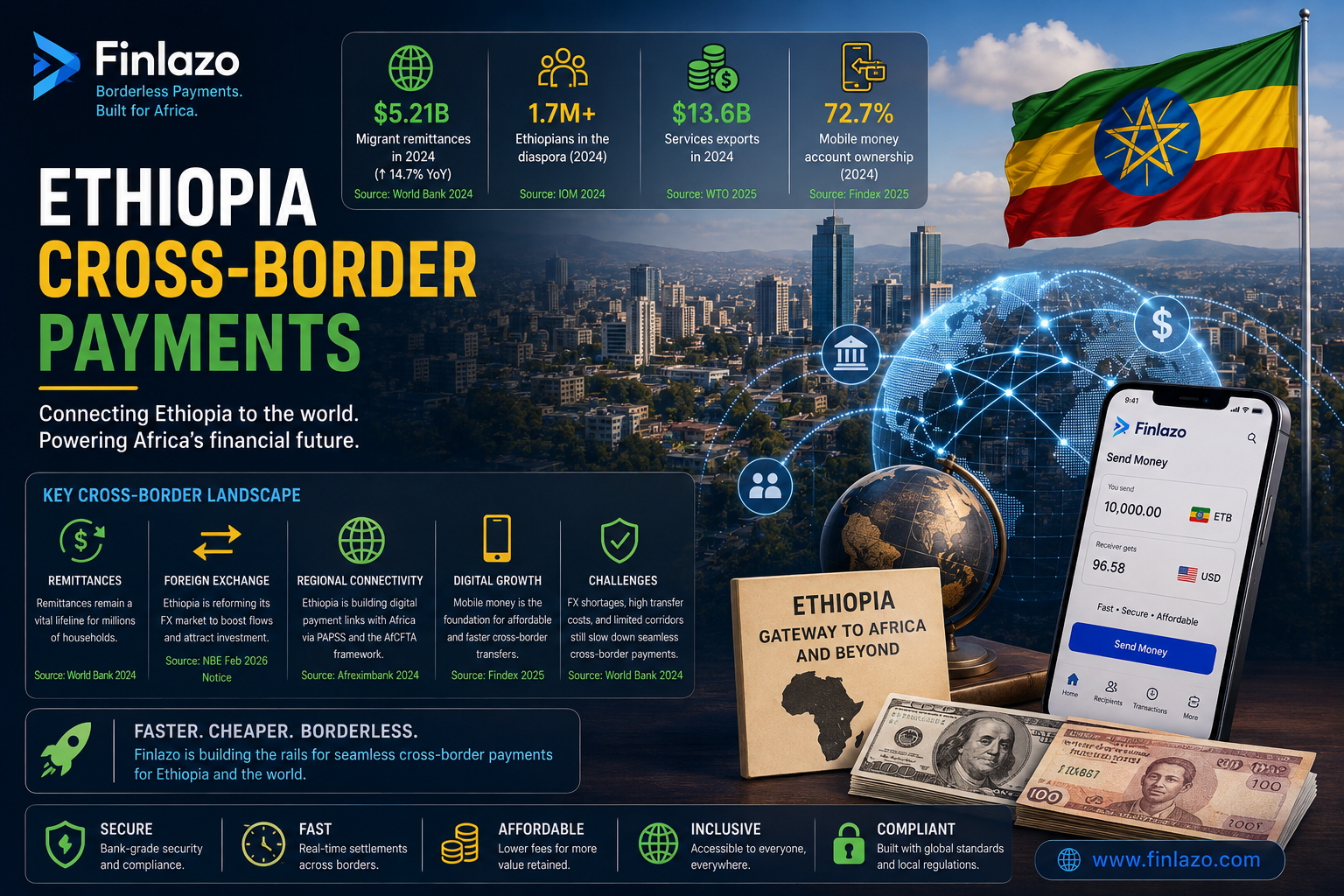
On this page
Ethiopia's cross-border payment market is changing quickly.
In the fiscal year 2024/25, foreign-exchange inflows reached a record US$32 billion, according to the National Bank of Ethiopia.
Private transfers and remittances contributed US$7.1 billion to those inflows.
The NBE's March 2026 Financial Stability Report said private remittance inflows increased by 13% in 2024/25.
At the same time, Ethiopia's formal digital-payment infrastructure is expanding. The NBE says mobile money accounts reached 139.5 million by 2025, while mobile banking accounts reached 54 million.
The scale of the domestic digital system matters because cross-border payments eventually have to enter or leave a local financial account.
Yet the NBE's own digital-payments strategy still identifies cross-border payments as limited.
Ethiopia is therefore facing two different realities.
Digital payments are expanding rapidly.
Cross-border connectivity still has room to develop.
Ethiopia Cross-Border Payments at a Glance
- US$32 billion — total foreign-exchange inflows recorded during the first year of Ethiopia's macroeconomic reform programme, covering fiscal 2024/25.
- US$7.1 billion — private transfers and remittances included in those inflows.
- 13% — increase in private remittance inflows during fiscal 2024/25.
- 139.5 million — mobile money accounts reported by the NBE in 2025.
- 54 million — mobile banking accounts reported by the NBE in 2025.
- 146% — compound annual growth rate in digital transaction volume between 2020 and 2025.
- 161% — compound annual growth rate in digital transaction value between 2020 and 2025.
- 3.5 million+ — annual transactions processed by the Ethiopian Automated Transfer System.
- Birr 5 trillion+ — aggregate value processed annually by EATS.
- 35 — participating financial institutions cited by the NBE for EATS.
- 120 seconds — PAPSS maximum stated processing time for eligible near-instant cross-border payments.
- 3,000 — maximum USD amount allowed for qualifying outbound family remittances by Ethiopians under the NBE's stated conditions.
These figures measure different parts of the payments ecosystem.
They should not be treated as one total cross-border payment figure.
Why Cross-Border Payments Matter to Ethiopia
Ethiopia has a large population abroad and deep commercial links with other economies.
Money comes into the country through remittances, exports, investment and other foreign-exchange sources.
Money also leaves Ethiopia to pay for imports, services, education, travel and other legitimate international obligations.
The NBE said the first year of its reform programme generated US$32 billion in foreign-exchange inflows.
That included US$7.1 billion in private transfers and remittances.
Those flows make cross-border payment infrastructure an important part of Ethiopia's financial system.
The question is not whether money crosses the border.
It clearly does.
The question is how efficiently it moves.
Remittances Are a Major Source of Foreign Exchange
Remittances are especially important because they connect households in Ethiopia with family members living abroad.
The NBE said private transfers and remittances contributed US$7.1 billion during the first year of its macroeconomic reform programme.
The NBE's March 2026 Financial Stability Report said private remittance inflows rose 13% in fiscal 2024/25.
The central bank has therefore been trying to move more remittance activity into formal channels.
That matters for both households and the wider foreign-exchange market.
The NBE Is Encouraging Formal Remittance Channels
In September 2024, the NBE launched its DEBO remittance awareness campaign.
The campaign encouraged Ethiopians abroad and their families to use legal remittance channels.
The NBE said 76% of the billions of dollars remitted over the previous three years came from individuals in the Ethiopian diaspora.
That is why remittance infrastructure matters beyond payment convenience.
It also affects foreign-exchange visibility and the amount of money entering the formal financial system.
How Much Does It Cost to Send Money to Ethiopia?
The World Bank's Remittance Prices Worldwide database provides a useful corridor-level view.
For the United States-to-Ethiopia corridor, the World Bank collected data in August 2025.
Its third-quarter 2025 corridor average total cost was 3.14% for the records shown in the database.
For one US$200 online transfer, Xoom was listed at a 6.76% sender fee in the displayed record, alongside an exchange-rate adjustment that produced the database's stated total cost.
The database also contains provider and payout-method differences.
That matters because the price of a remittance is not determined by the headline fee alone.
The exchange rate can change the final amount received.
The UK-Ethiopia Corridor Shows the Same Problem
The United Kingdom is another major source of Ethiopian remittances.
The World Bank's third-quarter 2025 data show a corridor average total cost of 3.52%.
The provider-level results vary significantly.
For example, Remitly's displayed online transfer to an Ethiopian bank account had a total cost of 2.03%.
A different provider and delivery method could cost substantially more.
The lesson is simple.
Compare the full cost and the amount received.
Exchange Rates Matter as Much as Transfer Fees
Ethiopia's foreign-exchange market has undergone major reform.
The NBE said the official and parallel-market rates had largely converged to within a 15% gap after the reforms.
The bank also reported that the average official exchange rate moved from 56.0 birr per U.S. dollar in June 2024 to 119.3 birr per U.S. dollar in June 2025.
That was a major shift.
It also means exchange-rate conditions need to be considered whenever the cost of an international transfer is analysed.
A transfer can have a low fee and still produce a poor final exchange rate.
Ethiopia's Digital Payment Infrastructure Is Expanding
Cross-border payments do not exist separately from domestic digital payments.
The NBE's Digital Payments Strategy says mobile money accounts increased from 12.2 million in 2020 to 139.5 million in 2025.
Mobile banking accounts increased from 9.1 million to 54 million over the same period.
The strategy says annual digital transaction volume grew at a 146% compound annual rate between 2020 and 2025.
Digital transaction value grew at a 161% compound annual rate.
Those numbers are remarkable.
But they are domestic digital-payment indicators.
They do not mean that cross-border payments grew at the same rates.
The Ethiopian Automated Transfer System
The country's high-value payment infrastructure is also being upgraded.
The NBE upgraded the Ethiopian Automated Transfer System (EATS) to ISO 20022 in March 2025.
EATS processes more than 3.5 million transactions annually, with aggregate value above Birr 5 trillion.
The NBE said 35 financial institutions participate in the system.
ISO 20022 gives payment messages a richer common structure.
That can improve payment information, reconciliation and processing.
It does not automatically make an international transfer instant.
What Is Ethiopia's Cross-Border Payment Strategy?
Ethiopia's Digital Payments Strategy 2.0 recognises that cross-border payments remain limited.
The NBE's strategy identifies the need to build more interoperable infrastructure and to enable secure, affordable cross-border payments.
It also envisions connecting Ethiopia's national payment infrastructure with external systems.
That is important because Ethiopia's domestic payment network is growing faster than its cross-border connectivity.
The policy challenge is therefore becoming one of interoperability.
Ethiopia and Regional Payment Connectivity
Africa is building several regional payment systems.
PAPSS is the most prominent continental example.
The PAPSS live-bank list shows which institutions are connected across participating countries.
As of the April 2026 list, Kenya and Rwanda had live commercial banks, while several other countries were also connected.
Ethiopia did not appear in that published April 2026 list.
That is important.
PAPSS is not a general switch that automatically covers every African market.
A country and its participating financial institutions need to be connected.
PAPSS and the Ethiopia Question
PAPSS states that eligible near-instant payments can be processed within 120 seconds.
The system is designed to allow payments in local African currencies and reduce unnecessary hard-currency conversions.
That could be useful for Ethiopia.
But Ethiopia's current position in the PAPSS network should be described carefully.
The April 2026 commercial-bank list reviewed for this article did not show an Ethiopian bank.
The absence from that list does not prove that Ethiopia can never participate.
It simply means PAPSS should not be presented as an already-live retail rail for Ethiopian customers unless an official connection is confirmed.
Ethiopia and the UAE
Ethiopia is also pursuing bilateral payment connectivity.
In July 2024, the NBE and the Central Bank of the United Arab Emirates signed agreements to promote the use of local currencies and link payment and messaging systems.
The currency swap had a nominal value of up to AED 3 billion and ETB 46 billion.
The agreements also covered the use of local currencies for cross-border transactions and the interlinking of payment and messaging systems.
This is a different model from PAPSS.
It is bilateral rather than continental.
Foreign-Exchange Reform Has Changed Cross-Border Payments
Ethiopia's foreign-exchange reforms are central to international payments.
The NBE introduced a new foreign-exchange system in July 2024.
By May 2025, the bank said reforms had increased flexibility for importers and travellers.
The NBE's foreign-exchange measures said goods exports had risen by more than 100% after the launch of the new system, while services, remittances and capital inflows had also increased.
The reforms were intended to improve the availability and functioning of foreign exchange.
That affects cross-border payments directly.
Outbound Family Remittances
Ethiopia's rules also cover certain outbound family remittances.
The NBE's foreign-exchange notice says qualifying Ethiopians can make outbound family remittance payments of up to US$3,000 subject to the stated conditions and documentation.
This is a specific foreign-exchange allowance.
It should not be confused with a universal retail transfer limit applying to every cross-border transaction.
Why Cross-Border Payments Remain Difficult
The NBE itself identifies cross-border payments as an area that remains limited.
Several factors help explain why.
Ethiopia uses the birr.
International transfers often involve foreign currencies.
The country also has a tightly managed foreign-exchange environment.
Different payment networks have different rules.
Banking relationships and compliance checks add another layer.
The customer may therefore experience a simple transfer request while several systems operate behind it.
Can Mobile Money Receive International Transfers?
Mobile money is now widespread domestically.
The NBE reported 139.5 million mobile money accounts in 2025.
That does not mean all of those accounts can receive international remittances directly.
Cross-border wallet delivery depends on the provider, the sending market, correspondent relationships and applicable regulatory approvals.
The important opportunity is connectivity.
A sender overseas could ideally fund a transfer while the recipient receives birr through a bank account or wallet.
That is the experience modern payment infrastructure is trying to make easier.
What About Stablecoins and Cross-Border Payments?
Stablecoins could theoretically provide another settlement layer.
A digital asset can move across a blockchain without using the same correspondent-banking path as a conventional international transfer.
But that does not solve the entire transaction.
The sender still needs a compliant on-ramp.
The recipient needs an off-ramp.
Liquidity is necessary.
Foreign-exchange and financial-crime rules still apply.
This is particularly important in Ethiopia because the NBE has maintained a restrictive position toward virtual-asset activity.
For the crypto-regulatory side, see Ethiopia cryptocurrency regulation.
Stablecoins should therefore be discussed as a potential future settlement technology, not as a currently authorised shortcut around Ethiopia's payment or foreign-exchange rules.
What Ethiopia Could Gain From Better Cross-Border Payments
The benefits are broader than remittances.
Faster payment connectivity can help exporters receive funds.
It can help importers settle suppliers.
It can support SMEs trading across African borders.
It can make diaspora payments easier.
It can also reduce the number of intermediaries involved in some transactions.
The NBE's digital-payments strategy explicitly connects better cross-border infrastructure with financial inclusion and economic growth.
That is why the issue sits inside Ethiopia's broader digital-finance agenda.
Ethiopia Cross-Border Payments Statistics
- US$32 billion — foreign-exchange inflows during the first year of the macroeconomic reform programme.
- US$7.1 billion — private transfers and remittances included in those inflows.
- 13% — growth in private remittance inflows in fiscal 2024/25.
- 3.14% — U.S.-to-Ethiopia third-quarter 2025 corridor average total cost shown by the World Bank.
- 3.52% — UK-to-Ethiopia third-quarter 2025 corridor average total cost shown by the World Bank.
- 139.5 million — mobile money accounts in 2025.
- 54 million — mobile banking accounts in 2025.
- 146% — annual digital transaction-volume CAGR from 2020 to 2025.
- 161% — annual digital transaction-value CAGR from 2020 to 2025.
- 3.5 million+ — annual EATS transactions.
- Birr 5 trillion+ — annual value processed by EATS.
- 35 — financial institutions participating in EATS.
- AED 3 billion and ETB 46 billion — maximum nominal values of the UAE-ETB currency swap arrangement.
- US$3,000 — stated ceiling for qualifying outbound family remittances by Ethiopians under the NBE's conditions.
- 120 seconds — PAPSS stated maximum processing time for eligible near-instant payments.
Frequently Asked Questions
How much money does Ethiopia receive in remittances?
The NBE said private transfers and remittances contributed US$7.1 billion during the first year of its macroeconomic reform programme. The NBE also reported a 13% increase in private remittance inflows during fiscal 2024/25.
How much does it cost to send money to Ethiopia?
Costs vary by corridor and provider. The World Bank's third-quarter 2025 data showed an average total cost of 3.14% for the United States-to-Ethiopia corridor and 3.52% for the United Kingdom-to-Ethiopia corridor.
Can someone send money to Ethiopia through mobile money?
This depends on the sending service and the receiving provider. Ethiopia has a large domestic mobile-money market, with 139.5 million mobile money accounts reported by the NBE in 2025, but that figure does not mean every account can receive international remittances.
Does Ethiopia use PAPSS for cross-border payments?
PAPSS is designed for African local-currency cross-border payments, but the April 2026 live-bank list reviewed for this article did not show an Ethiopian bank. PAPSS says eligible near-instant payments can process within 120 seconds, but Ethiopia should not be described as having live retail PAPSS coverage without an official confirmation.
Why are cross-border payments important to Ethiopia?
They support remittances, trade, investment and other international transactions. The NBE reported US$32 billion in foreign-exchange inflows during the first year of its macroeconomic reform programme, including US$7.1 billion in private transfers and remittances.
The Bottom Line
Ethiopia's cross-border payments market is large in economic importance but still developing in terms of connectivity.
Remittances are a major source of foreign exchange.
Digital payment infrastructure is expanding rapidly.
The NBE says mobile money accounts reached 139.5 million in 2025, while mobile banking accounts reached 54 million.
The country has also upgraded its high-value payment infrastructure.
EATS now processes more than 3.5 million transactions annually with aggregate value above Birr 5 trillion.
The harder problem is cross-border interoperability.
The NBE's digital-payments strategy still describes cross-border payments as limited.
Regional and bilateral initiatives are being explored.
Ethiopia has also strengthened payment and currency links with the UAE.
PAPSS offers another model for African local-currency settlement, although Ethiopia's current live-bank connectivity needs to be verified before the system is presented as an active retail route.
The direction is clear.
Ethiopia is building a more digital domestic payment system while working to improve how that system connects to the rest of the world.