What Happened to NoOnes? Lessons for Africa's Crypto Industry
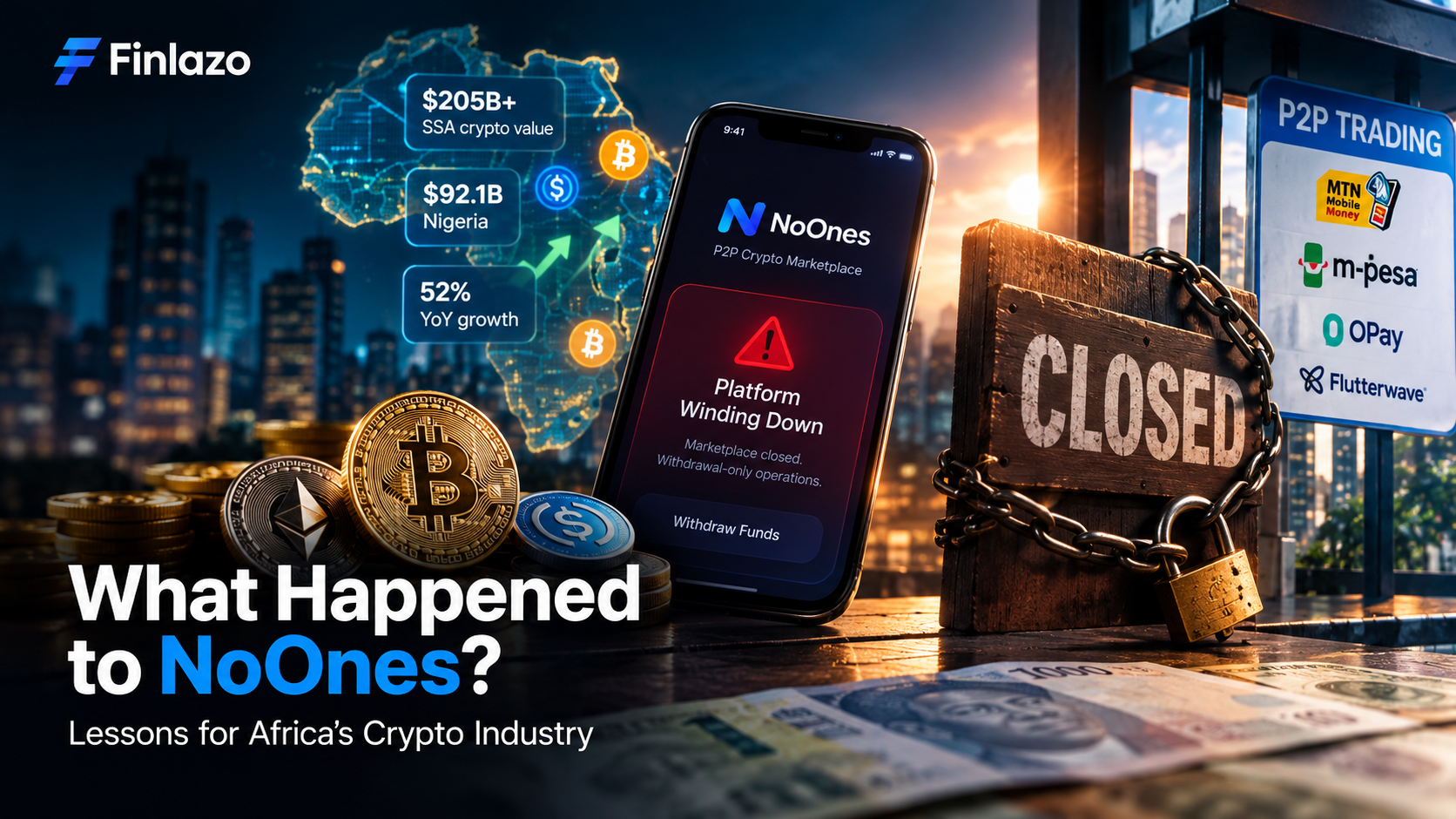
NoOnes is winding down its P2P marketplace after more than 2.5 million users. Explore what happened, the latest African crypto market data, and key lessons for crypto platforms.

On this page
The cryptocurrency industry has just lost one of its more prominent peer-to-peer platforms.
On August 17, 2026, NoOnes began winding down several of its services. Four days later, on August 21, its P2P marketplace closed. The company subsequently moved into a withdrawal-only phase, leaving customers able to access balances and withdraw funds but no longer trade on the marketplace.
The scale of the shutdown is significant. According to NoOnes' own announcement, the platform had served more than 2.5 million users over more than three years. The company said sanctions-related difficulties caused it to lose access to essential partners, while blockchain-monitoring providers classified NoOnes-related wallets and transactions as high risk.
For African cryptocurrency users, the story matters for reasons that extend far beyond one P2P marketplace. NoOnes' closure raises a much bigger question:
What happens when a crypto platform's ability to operate depends not only on its own technology, but also on banks, exchanges, payment providers, blockchain-monitoring companies and other external partners?
For Africa, where cryptocurrency has increasingly become part of the financial infrastructure used for remittances, currency protection, commerce and cross-border transfers, that question deserves serious attention. This article examines the NoOnes shutdown, the broader African crypto market and the lessons that the episode offers to users and crypto businesses.
This analysis is based on information available as of August 23, 2026. It distinguishes between statements made by NoOnes, official regulatory information and independent industry data. It does not attempt to determine legal liability or make conclusions beyond the available evidence.
What Happened to NoOnes?
NoOnes announced on August 17 that it would begin closing several services, including:
- P2P marketplace services
- NoOnes Swap
- NoOnes Visa
- Crypto off-ramps
- Gift Card Store
- Bitcoin Lightning Network
- Partner Program payouts
- New account registrations
- Most USDT networks
The company said the changes were connected to an ongoing EU sanctions situation and that its partners could no longer continue supporting several NoOnes services. The timeline was remarkably fast.
- 1August 17: service wind-down began.
- 2August 21: P2P marketplace closed.
- 3After August 21: NoOnes moved into withdrawal-only operations.
The company said customers could still sign in, view balances, withdraw funds and contact support, but trading and other platform services would no longer be available. The remaining supported withdrawal routes were Bitcoin through the regular Bitcoin network and USDT through TRON (TRC-20).
For anyone who has spent years around P2P cryptocurrency markets, that sequence is significant. A platform that had operated a marketplace, wallet, payment services and other products effectively transitioned from a financial marketplace into an exit mechanism for customers.
Why Did NoOnes Shut Down?
This requires careful wording. The available evidence does not justify reducing the story to “the EU shut down NoOnes.” NoOnes' own communications describe a more complicated sequence.
The company said sanctions affected it, caused it to lose access to essential partners and resulted in blockchain-monitoring providers classifying NoOnes-related wallets and transactions as high risk. It said these restrictions made transactions increasingly difficult to process and ultimately made continuing operations unsustainable.
There is also an important piece of chronology. Following the EU sanctions announcement, NoOnes published a clarification stating that the EU documents named NoOneCrypto Inc., which it described as a separate legal entity that was not involved in management or operation of the NoOnes platform. NoOnes said at the time that neither the platform nor its current operating entity was named in the EU measure.
That statement should not simply be ignored. But neither should the later shutdown announcement.
The later announcement confirms that, regardless of the company's earlier clarification about the legal entity named in the sanctions listing, the sanctions situation had practical consequences for NoOnes' relationships with external partners and compliance providers. That distinction is critical.
Legal designation and operational consequences are not necessarily the same thing.
A company may dispute whether a particular designation legally applies to it while simultaneously experiencing commercial consequences because banks, exchanges, compliance providers or blockchain-monitoring companies decide that transactions involving the company present unacceptable risk. That is one of the biggest lessons from the NoOnes episode.
The Global Crypto Compliance Environment Is Getting More Sophisticated
NoOnes' experience also needs to be viewed against the broader direction of cryptocurrency regulation. The European Union's 21st sanctions package against Russia, adopted on July 23, 2026, specifically strengthened restrictions involving financial services and crypto. The European Commission said the package introduced a dedicated third-country ban for certain crypto-asset services and imposed transaction bans on additional third-country crypto platforms and crypto-linked firms.
The EU package contained 218 additional listings, including 48 individuals and 170 entities, according to the European Commission. That broader environment matters.
Crypto companies increasingly operate inside a financial system where: Blockchain activity → compliance monitoring → exchanges → banks → payment providers → and regulators, are interconnected. The idea that a cryptocurrency platform can operate independently of the traditional financial system is becoming increasingly difficult to sustain at scale.
Africa's Crypto Market Is Much Bigger Than the NoOnes Story
It would be a mistake to interpret the NoOnes shutdown as evidence that cryptocurrency adoption in Africa is declining. The available data suggests almost the opposite.
Chainalysis estimated that Sub-Saharan Africa received more than $205 billion in on-chain cryptocurrency value between July 2024 and June 2025, representing approximately 52% year-over-year growth. That made the region the third-fastest-growing crypto region globally in the period measured.
The numbers become even more interesting when the transactions are examined by size. Chainalysis found that more than 8% of the value transferred in Sub-Saharan Africa during that period involved transfers below $10,000, compared with 6% in the rest of the world. That suggests cryptocurrency activity in the region is not simply an institutional trading phenomenon. It is connected to everyday financial activity. And Africa's largest markets are producing enormous transaction volumes.
Nigeria Alone Recorded More Than $92 Billion in Crypto Value
Nigeria is particularly important. Chainalysis data cited in its 2025 regional analysis puts Nigeria's crypto transaction value at approximately $92.1 billion during the relevant period.
The International Monetary Fund has also highlighted Nigeria's growing role in the stablecoin economy. An IMF analysis published in June 2026 estimated that Nigeria received approximately $59 billion in crypto-asset inflows between July 2023 and June 2024 and noted that Nigeria accounted for roughly 60% of stablecoin inflows into Sub-Saharan Africa since 2019.
These figures matter because they show why the future of African crypto cannot be reduced to speculative Bitcoin trading. People are using digital assets within an increasingly complex financial ecosystem. They are interacting with:
- Foreign exchange - Remittances - International commerce - Savings - Stablecoins - P2P markets - Payment services - Cross-border transfers That makes platform resilience and regulatory compliance increasingly important.
Bitcoin Still Dominates African Crypto Activity
The African market also has some distinctive characteristics. Chainalysis found that Bitcoin represented 89% of crypto purchases made with fiat in Nigeria and 74% in South Africa during the period covered by its 2025 regional analysis.
That doesn't mean Africans only use Bitcoin. Stablecoins have become increasingly important for payments, transfers and currency-related use cases. But it demonstrates that Bitcoin remains deeply embedded in the region's crypto economy.
For P2P platforms, this matters because Bitcoin has historically been one of the most important assets used for local-currency trading.
Why P2P Became So Important in Africa
Peer-to-peer cryptocurrency markets developed for a reason. In many emerging markets, access to international financial infrastructure can be expensive, slow or restricted. P2P marketplaces offered an alternative model. A user could find another person willing to exchange cryptocurrency for:
- Local currency
- Mobile money
- Bank transfers
- Payment applications
- Other forms of value
The platform provided the marketplace and, in many cases, escrow and dispute-resolution infrastructure. This was particularly relevant in markets where traditional international payment systems did not adequately serve users. P2P therefore became more than a trading mechanism. For many users, it became a financial access mechanism.
That is one reason the disappearance of a major P2P platform deserves more attention than simply another cryptocurrency-company closure.
Lesson 1: A Crypto Platform Is Only as Strong as Its External Infrastructure
This may be the biggest lesson from NoOnes. A cryptocurrency company can build excellent:
- Software - Wallet infrastructure - P2P matching - Escrow systems - Mobile applications - User interfaces - Security controls But it still depends on an ecosystem of external providers. That ecosystem can include:
- Banks
- Payment processors
- Liquidity providers
- Blockchain analytics companies
- Compliance providers
- Exchanges
- Card networks
- Fiat off-ramps
- Custodians
- Technology providers
If several of those relationships disappear simultaneously, a technically functional platform can become commercially unusable. NoOnes' own explanation makes this point particularly clearly: the company said sanctions-related restrictions caused it to lose access to essential partners and that blockchain-monitoring providers classified its wallets and transactions as high risk.
The lesson for African fintech founders is straightforward: Infrastructure redundancy is not optional when money is moving through your platform.
Lesson 2: Compliance Risk Can Become Commercial Risk
Many technology founders think about compliance as a regulatory department. Financial infrastructure companies have to think differently. Compliance affects: - - Whether a bank will work with you. - Whether an exchange will accept your deposits. - Whether a payment provider will process your transactions. - Whether blockchain analytics companies classify your wallet activity as acceptable. - Whether institutional partners are comfortable integrating with you. - That means compliance isn't simply about avoiding regulatory penalties. - It can determine whether the business can actually operate.
NoOnes' experience illustrates this distinction. The company's announcement says the restrictions created delays, rejections and restrictions involving transfers from NoOnes to certain exchanges and services. In other words, compliance risk became a payments and liquidity problem. That is a much bigger issue.
Blockchain Transparency Does Not Eliminate Compliance Risk
One of cryptocurrency's most important characteristics is that many blockchain networks provide transparent transaction histories. But transparency doesn't mean every transaction is automatically considered low risk. Blockchain-monitoring companies analyze transaction histories and wallet relationships to identify potential exposure to: - Sanctioned entities - High-risk services - Fraud - Hacks - Money laundering - Illicit markets - Other risk indicators
NoOnes specifically said external blockchain-monitoring providers classified NoOnes-related wallets and transactions as high risk. This is important for the next generation of African crypto businesses. On-chain compliance needs to be designed into the product. It cannot simply be added after the platform has millions of users.
Lesson 4: P2P Platforms Need Stronger Compliance Architecture as They Scale
P2P marketplaces have an unusual compliance challenge. Unlike a conventional centralized exchange, the platform may facilitate transactions between thousands or millions of independent users. That creates several layers of risk. A platform needs to understand: - Who is the customer? - Who is the counterparty? - Where did the crypto come from? - Where is it going? - What payment method is being used? - Does the transaction interact with a sanctioned address? - Does the transaction pattern indicate fraud? - Is someone attempting to circumvent platform controls?
NoOnes' own historical compliance documentation demonstrates how seriously P2P platforms have to treat these questions. Its support materials describe restrictions involving false identification, multiple accounts, chargebacks, illegal activity, heightened blockchain risk and attempts to circumvent platform controls. The lesson is not that P2P itself is inherently problematic. The lesson is that P2P requires sophisticated compliance infrastructure at scale.
Lesson 5: Customer Funds Need an Exit Strategy
The final days of a financial platform can reveal how resilient its architecture really is. NoOnes moved to a withdrawal-only model after closing the P2P marketplace.
The company maintained Bitcoin withdrawals and USDT withdrawals through TRC-20 while discontinuing other services. For customers, this raises an important question: If a platform stops trading tomorrow, can customers still access and move their assets? That question should be asked before depositing funds, not after a shutdown announcement. For platforms themselves, it highlights the importance of designing clear and resilient withdrawal infrastructure.
Lesson 6: Diversification of Payment and Liquidity Partners Matters
A crypto platform that relies on a single provider for a critical function creates concentration risk. Imagine a platform depends on: - One bank → bank exits - One card provider → card provider exits - One off-ramp → off-ramp exits - One liquidity provider → liquidity disappears
The platform can quickly become operationally constrained. NoOnes' experience demonstrates why crypto businesses should think about partner concentration in the same way that banks think about operational and counterparty risk. A serious African financial platform should consider: - Multiple banking relationships - Multiple payment providers - Multiple liquidity sources - Multiple blockchain-monitoring providers where practical - Multiple supported settlement routes - Disaster-recovery infrastructure - Clear customer withdrawal procedures
Redundancy costs money. But the absence of redundancy can cost the entire business.
Africa's Crypto Market Is Moving Toward Institutional Infrastructure
The timing of the NoOnes shutdown is particularly interesting because African cryptocurrency markets are simultaneously becoming more institutionalized. Chainalysis describes South Africa as having an increasingly institutionalized crypto market, supported by its regulatory framework and hundreds of licensed virtual asset service providers. It also notes institutional interest in custody and stablecoin-related products.
This represents a significant shift. The African crypto industry is moving from P2P marketplaces toward a much broader ecosystem involving: Licensed CASPs → banks → stablecoins → payment providers → custody → compliance infrastructure → institutional settlement.
That doesn't mean P2P disappears. It means the infrastructure surrounding cryptocurrency is becoming more sophisticated.
Stablecoins Are Changing the Conversation
Another major development is the growth of stablecoins. They are increasingly being used for purposes that have little to do with speculative trading. They can provide a digital representation of value linked to currencies such as the U.S. dollar while allowing users to transfer that value using blockchain infrastructure.
Chainalysis identifies stablecoins as increasingly important in remittances, commerce and inflation hedging. The IMF's analysis of Nigeria provides another indication of their importance, noting that Nigeria accounts for approximately 60% of stablecoin inflows into Sub-Saharan Africa since 2019.
This matters because stablecoins can create a different kind of demand for African crypto infrastructure. Instead of: Buy Bitcoin → wait for price appreciation, the use case becomes: Receive dollars digitally → transfer value internationally → settle locally.
That is much closer to financial infrastructure. And that is precisely why compliance, payment connectivity and settlement reliability become so important.
The NoOnes Story Is Also a Warning About Regulatory Fragmentation
Africa doesn't have one cryptocurrency regulator. It has dozens of financial systems, currencies, payment networks and regulatory environments. A platform operating across Kenya, Nigeria, Ghana, South Africa, Tanzania or Uganda may encounter completely different licensing and compliance expectations in each jurisdiction.
A company cannot simply assume: “We are compliant in country A, therefore we can operate in country B.” That is particularly important as governments develop frameworks for virtual assets, stablecoins and digital payments. The result is that regulatory architecture becomes part of the product architecture.
What Should African Crypto Companies Learn From NoOnes?
The lessons can be summarized into seven principles.
- 1Build compliance into the product - Don't treat compliance as paperwork added before launch. Design KYC, transaction monitoring, sanctions screening and risk management into the core architecture.
- 1Diversify critical partners - Don't allow one banking, liquidity, payment or compliance relationship to become a single point of failure.
- 1Build resilient withdrawal infrastructure - Customers should have a clear mechanism for accessing their assets if trading services are interrupted.
- 1Monitor on-chain exposure continuously - Wallet risk can change. A previously acceptable counterparty may later become associated with sanctions, hacks or other high-risk activity.
- 1Separate jurisdictions operationally - Different African countries have different regulatory requirements. Expansion should therefore include country-specific compliance assessments.
6. Treat sanctions risk as an operational issue - Sanctions aren't simply a legal department concern. They can affect: - Banking - Liquidity - Exchanges - Payment processors - Blockchain monitoring - Customers - Withdrawals
- 1Build trust before you need it - A company facing a crisis has little time to establish relationships with banks, regulators, payment providers and compliance partners. Those relationships should already exist.
What NoOnes Means for African Crypto Users
For users, the lesson isn't: “Don't use crypto.” Nor is it: “Don't use P2P.” The lesson is to understand the risks of keeping assets on any centralized platform. Users should consider: 1. Who controls the platform? 2. Where is the company based? 3. What regulatory framework applies? 4. How are customer funds held? 5. What withdrawal networks are available? 6. Does the platform have clear compliance policies? 7. What happens if a major service is discontinued? 8. Can assets be moved to self-custody? 9. How dependent is the platform on third-party providers?
NoOnes itself advised customers during the wind-down to withdraw their balances and warned that transfers involving the platform could be delayed, rejected or restricted by external providers. That is a powerful reminder that access to crypto is not the same thing as guaranteed access to liquidity.
What This Means for Fintech Builders
Perhaps the most important lesson from NoOnes is relevant far beyond cryptocurrency. African fintech founders are increasingly building products that connect: Local currencies → Payment networks → Digital assets → Global liquidity → International settlement
The technology may look different from traditional banking, but the fundamental challenge is similar: Can the infrastructure continue operating when one component fails? A successful financial platform therefore needs more than an attractive application. It needs: - Compliance - Liquidity - Banking relationships - Payment connectivity - Security - Risk management - Operational resilience - Regulatory relationships - Customer suppor - Reliable withdrawals
That is the difference between building a crypto application and building financial infrastructure.
NoOnes and the Future of African Crypto
NoOnes' shutdown is unlikely to stop cryptocurrency adoption in Africa. The underlying demand remains visible in the data. Sub-Saharan Africa recorded more than $205 billion in on-chain crypto value in the year to June 2025, with activity growing approximately 52% year over year. Nigeria alone accounted for approximately $92.1 billion, while the IMF has highlighted the country's particularly important role in the regional stablecoin market.
The market is therefore not disappearing. It is evolving. The next generation of African crypto companies may look very different from the P2P marketplaces that dominated the previous era. They may be: - Licensed - Bank-connected - Stablecoin-enabled - Compliance-heavy - Institutionally integrated - Built around cross-border settlement - Connected to local payment rails
The companies that survive may not necessarily be the ones with the largest user numbers. They may be the ones with the strongest infrastructure underneath those users.
Conclusion: The Biggest Lesson From NoOnes
NoOnes built a community of more than 2.5 million users in just over three years. That alone demonstrates how quickly demand for alternative financial infrastructure can develop.
But its shutdown demonstrates something equally important. User growth is not the same thing as infrastructure resilience. A platform can have millions of users and still depend on a relatively small number of external relationships that determine whether those users can trade, withdraw, convert or move funds.
For Africa's next generation of cryptocurrency and fintech companies, that is perhaps the most important lesson. The future of African crypto will probably not be built solely around P2P trading. It will increasingly involve stablecoins, regulated digital-asset businesses, local payment rails, cross-border settlement, compliance infrastructure and institutional financial connectivity.
The opportunity is enormous. So is the responsibility. NoOnes' story should therefore not be remembered simply as the story of a P2P platform that closed. It should be studied as a case study in what happens when regulation, sanctions, compliance infrastructure and financial partnerships become inseparable from the operation of a crypto platform.
And for African fintech builders, that lesson may prove far more valuable than the platform itself.