How Digital Payments Are Transforming Africa's Financial System
Africa's financial system is rapidly shifting toward digital payments as mobile money, fintech, digital wallets, and instant-payment networks expand. Explore how these technologies are reshaping financial access, business payments, and the future of finance across the continent.

On this page
Africa's financial system is undergoing a major digital transformation.
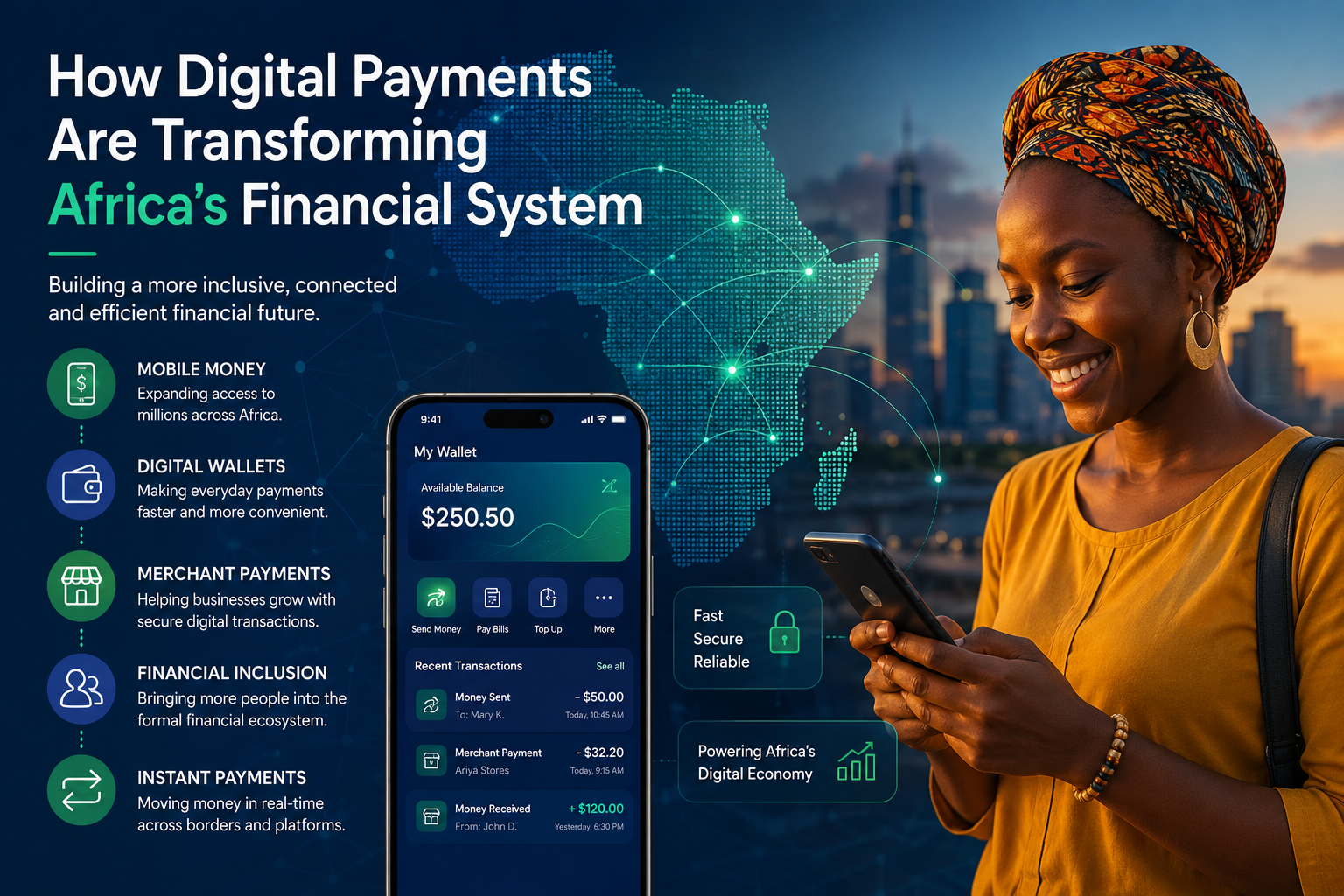
For decades, cash and traditional banking dominated everyday financial activity across much of the continent. Today, mobile phones, digital wallets, fintech platforms and instant-payment systems are changing how individuals and businesses send, receive and manage money.
The scale of that transformation is becoming difficult to ignore.
According to the GSMA's State of the Industry Report on Mobile Money 2026, more than $2.1 trillion flowed through mobile-money services globally in 2025, while registered mobile-money accounts reached 2.3 billion. Sub-Saharan Africa remains the world's leading mobile-money region, accounting for a particularly large share of new active accounts.
The transformation, however, is about more than mobile money.
Africa is gradually developing a broader digital financial ecosystem involving banks, fintech companies, digital wallets, payment gateways, fast-payment systems and emerging blockchain-based infrastructure.
The result could be a financial system that is increasingly digital, interconnected and accessible.
Africa's Shift From Cash to Digital Payments
The World Bank's Global Findex 2025 provides one of the clearest views of this transformation. The latest edition is based on nationally representative surveys of approximately 148,000 adults across 141 economies and includes new globally comparable data on mobile-phone ownership, internet use and digital safety.
The significance of mobile connectivity is particularly important.
A financial account is useful only if people can access and use it. A smartphone or mobile phone can provide the interface through which people interact with financial services without visiting a bank branch.
That creates a powerful combination:
Mobile connectivity + digital identity + payment infrastructure + financial services.
Together, these technologies can significantly reduce the barriers between consumers and the financial system.
Mobile Money Changed the Financial Landscape
Africa's digital-payment transformation cannot be discussed without mobile money.
Mobile money effectively demonstrated that financial services could be delivered through mobile networks rather than relying entirely on traditional bank branches.
The ecosystem has now grown far beyond basic person-to-person transfers.
The GSMA reported that mobile-money services processed more than $2 trillion globally in 2025, representing a 23% increase from 2024. Registered accounts reached 2.3 billion, while monthly active accounts increased to 593 million.
Merchant payments are becoming particularly important.
GSMA data shows that mobile-money merchant payments grew by almost half in 2025, reaching approximately $155 billion.
That is an important change.
Mobile money is no longer simply a mechanism for sending money to family members.
It is becoming part of the infrastructure businesses use to sell, pay, collect and manage money.
Sub-Saharan Africa Remains at the Center
Sub-Saharan Africa continues to dominate the global mobile-money landscape.
According to the GSMA's latest regional data, the region processed more than $1.4 trillion in mobile-money transactions during 2025, while accounting for approximately 76% of new active 90-day accounts globally during the year.
The region also had 174 live mobile-money services across 2025, compared with 170 the previous year.
This matters because Africa is not simply adopting an imported financial model. It is becoming one of the places where digital financial infrastructure is evolving most rapidly.
The Rise of Digital Wallets
Mobile money is one form of digital wallet, but the broader wallet ecosystem is expanding. Consumers can now interact with:
- Mobile-money wallets
- Bank applications
- Fintech wallets
- Cryptocurrency wallets
- Payment wallets
- Digital savings accounts
- Merchant wallets
A wallet can increasingly become the interface through which a user manages multiple financial activities. Instead of visiting a physical branch to transfer money, a customer can use a smartphone. Instead of paying a merchant with cash, the customer can scan a QR code or send a digital payment. Instead of receiving a physical statement, users can see their balances and transaction history instantly. The financial account is becoming increasingly digital.
Fintech Is Expanding Access to Financial Services
Fintech companies can build specialized services on top of existing financial infrastructure, creating products around payments, lending, savings, insurance, foreign exchange and investment.
This has created a more competitive financial environment. Instead of a customer relying exclusively on one traditional bank, they may interact with several financial providers through digital platforms.
The IMF's research on digital payment innovations in Sub-Saharan Africa identifies fast-payment systems, mobile money, crypto assets and central bank digital currencies as important areas of development. The institution argues that these innovations can potentially improve financial inclusion, efficiency and transaction costs, while also creating new regulatory and financial-stability challenges.
The important point is that fintech is not simply digitizing existing banking products. It is changing how financial services are delivered.
Digital Payments Are Changing How Businesses Operate
Consumers are not the only beneficiaries. Businesses are increasingly becoming digital-payment users themselves. A small retailer can accept mobile payments. A freelancer can receive money electronically. An employer can pay staff digitally. An online business can collect payments without maintaining a physical storefront. A supplier can receive payment without handling cash.
These capabilities can make businesses more efficient while reducing the operational risks associated with handling physical currency. Digital payment records can also create valuable transaction histories. For businesses operating in the informal economy, the ability to build a reliable digital financial record could eventually improve access to additional financial services.
Merchant Payments Are Becoming More Important
The growth of merchant payments is particularly significant. Historically, mobile money was heavily associated with person-to-person transfers.
That is changing. GSMA's 2026 report found that merchant payments reached $155 billion in 2025, making them the fastest-growing mobile-money use case during the year.
This suggests that digital payments are becoming embedded deeper into everyday commerce. A consumer may use a mobile wallet to buy groceries. A restaurant may accept digital payments. A small business may pay suppliers digitally. A delivery company may collect payments through a mobile platform.As these transactions become normal, digital payments become part of the underlying commercial infrastructure.
Instant Payments Could Change the Next Stage
The next major development is likely to involve speed and interoperability. Traditional payment systems can involve multiple institutions and settlement processes. Fast-payment systems are designed to move money much more quickly, often in real time or near real time.
The IMF identifies fast-payment systems as one of the key digital payment innovations developing across Sub-Saharan Africa. It also emphasizes the importance of interoperability, both within countries and across borders.
This could have significant implications for African commerce. Imagine a payment system where a customer can initiate a transaction through their bank while the recipient receives funds through a different financial institution or wallet. The two institutions do not necessarily need to operate the same technology. They need to be able to communicate.
Kenya Demonstrates the Power of Mobile Payments
Kenya provides one of the world's best-known examples of mobile-money adoption. The country's mobile-money ecosystem has become deeply embedded in everyday economic activity, from person-to-person transfers to merchant payments and business transactions. The broader African experience shows that mobile money can become much more than a payment product. It can become financial infrastructure.
The next challenge is connecting that infrastructure with other financial networks. A Kenyan user may have a mobile-money wallet, a bank account, a card and potentially a digital-asset wallet. The future of digital payments will increasingly depend on how easily those different systems can interact. That is the promise of interoperability
Nigeria Is Building a Different Digital-Payment Ecosystem
Nigeria provides another important example. The country's enormous population, large fintech sector and rapid adoption of digital financial services have created one of Africa's most dynamic payment markets. Digital payments have expanded across banking, fintech, mobile applications, merchant payments and cryptocurrency.
The IMF's 2025 research on digital payment innovation identifies Nigeria as one of the markets where new payment technologies are developing alongside traditional financial infrastructure.
The Nigerian experience demonstrates another important point: Digital payments do not necessarily eliminate traditional financial institutions. Instead, banks, fintechs, mobile networks and emerging digital-asset infrastructure can coexist.
Digital Payments and Financial Inclusion
One of the strongest arguments for digital payments is financial inclusion. A person who lives far from a bank branch may still have access to a mobile phone. A small business without sophisticated banking infrastructure may still be able to accept digital payments. A worker without access to international banking services may be able to receive money through a digital platform.
The World Bank's Global Findex 2025 specifically examines the relationship between financial inclusion and digital connectivity, including mobile-phone ownership, internet access and the use of digital financial services.
But access to technology does not automatically create financial inclusion. People also need affordable connectivity, digital literacy, secure identification, consumer protection and reliable payment infrastructure. That is why digital financial inclusion is ultimately an ecosystem problem, not simply a smartphone problem.
The Smartphone Is Becoming a Financial Gateway
The smartphone is increasingly becoming the interface through which people interact with financial services. A single device can provide access to:
- Payments
- Banking
- Mobile money
- Savings
- Insurance
- Credit
- Investments
- International transfers
This convergence is changing consumer expectations. People increasingly expect financial services to be available quickly, digitally and continuously. They do not necessarily care which institution provides each component. They care whether the service works. That creates an opportunity for fintech companies to build interfaces that simplify access to increasingly complicated financial infrastructure.
Stablecoins Could Add a Cross-Border Layer
Digital payments are also expanding beyond domestic transactions. Stablecoins are increasingly being examined as a possible settlement mechanism for cross-border payments because they can represent relatively stable, dollar-denominated value on blockchain networks.
The IMF's recent research on Nigeria highlights the growing importance of stablecoins in cross-border activity, while its broader work on Sub-Saharan Africa notes that digital payment innovations can potentially improve efficiency and reduce transaction costs.
A possible future transaction could look like: Local currency to Digital payment provider to Stablecoin settlement to Local payment provider to Recipient's currency. The customer may never need to interact directly with the blockchain. The digital asset can simply operate as infrastructure behind the payment. This is particularly interesting for businesses and individuals moving money between countries with different currencies and financial systems.
Security Will Become More Important
The expansion of digital payments also creates new risks.The more money that moves digitally, the greater the importance of:
- Fraud prevention
- Account security
- Identity verification
- Transaction monitoring
- Cybersecurity
- Consumer protection
GSMA's 2026 mobile-money research notes that fraud remains a widespread challenge and that transaction taxes in some markets can encourage users to return to cash.
This means that successful digital-payment platforms will have to compete on more than convenience. Trust will become a competitive advantage. Users need to know that their money is secure and that they have a clear process for resolving problems when something goes wrong.
Regulation Will Shape Digital Payments
Digital financial services operate within regulatory environments that vary considerably between African countries. Payment providers may need to comply with requirements involving:
- Know Your Customer procedures
- Anti-money-laundering controls
- Consumer protection
- Data protection
- Licensing
- Foreign exchange
- Payment-system regulation
- Digital-asset regulation
The IMF's research emphasizes that digital-payment innovation creates opportunities but also introduces policy challenges, particularly where institutional capacity and technological infrastructure remain uneven. Regulation will therefore play an important role in determining which digital-payment models can scale sustainably.
Interoperability Could Define the Next Phase
The next stage of Africa's digital-payment transformation may not be about creating more isolated wallets. It may be about making existing systems communicate.
Consider a future where: Bank → Mobile Money, Mobile Money → Bank, Fintech → Bank, Wallet → Merchant, Digital Asset → Local Currency, Country A → Country B can all happen through connected payment infrastructure. The user should not need to understand which system is being used. The infrastructure should select the most appropriate route based on factors such as:
- Cost
- Speed
- Liquidity
- Currency
- Regulation
- Availability
This is where interoperability becomes more than a technical concept. It becomes a consumer benefit.
Africa's Digital Payment Economy Is Still Evolving
Africa's digital-payment transformation is far from finished. Mobile money continues to grow. Digital wallets are becoming more sophisticated. Fintech companies are expanding into new financial services. Fast-payment systems are developing. Merchant payments are increasing. Stablecoins are creating new possibilities for international settlement. And governments and regulators are increasingly focused on building secure digital financial infrastructure.
The opportunity is therefore much larger than simply replacing cash. It is about building a financial ecosystem capable of moving money quickly, securely and efficiently between people, businesses and markets.
What Comes Next?
The next generation of African digital payments will likely be defined by integration. Mobile money will continue serving millions of users. Banks will remain essential to the financial system. Fintech companies will continue developing new digital experiences. Fast-payment systems will improve domestic settlement.
Stablecoins and blockchain networks may provide additional cross-border settlement options. And digital wallets may increasingly become the primary interface through which people manage their financial lives. The technologies may differ. The objective is the same: Make financial services easier to access and easier to use.
The Bottom Line
Africa's digital-payment transformation is no longer a prediction. It is already happening. Mobile money has reached extraordinary scale, processing more than $2 trillion globally in 2025, while registered accounts have reached 2.3 billion. The next stage will be about what happens on top of that infrastructure.
Fintech companies, banks, mobile-money providers, fast-payment systems and emerging blockchain networks can increasingly work together to create a more connected financial ecosystem. The biggest opportunity may not be to replace the systems Africa has already built. It may be to connect them.