How Digital Finance Is Expanding Financial Inclusion in Africa
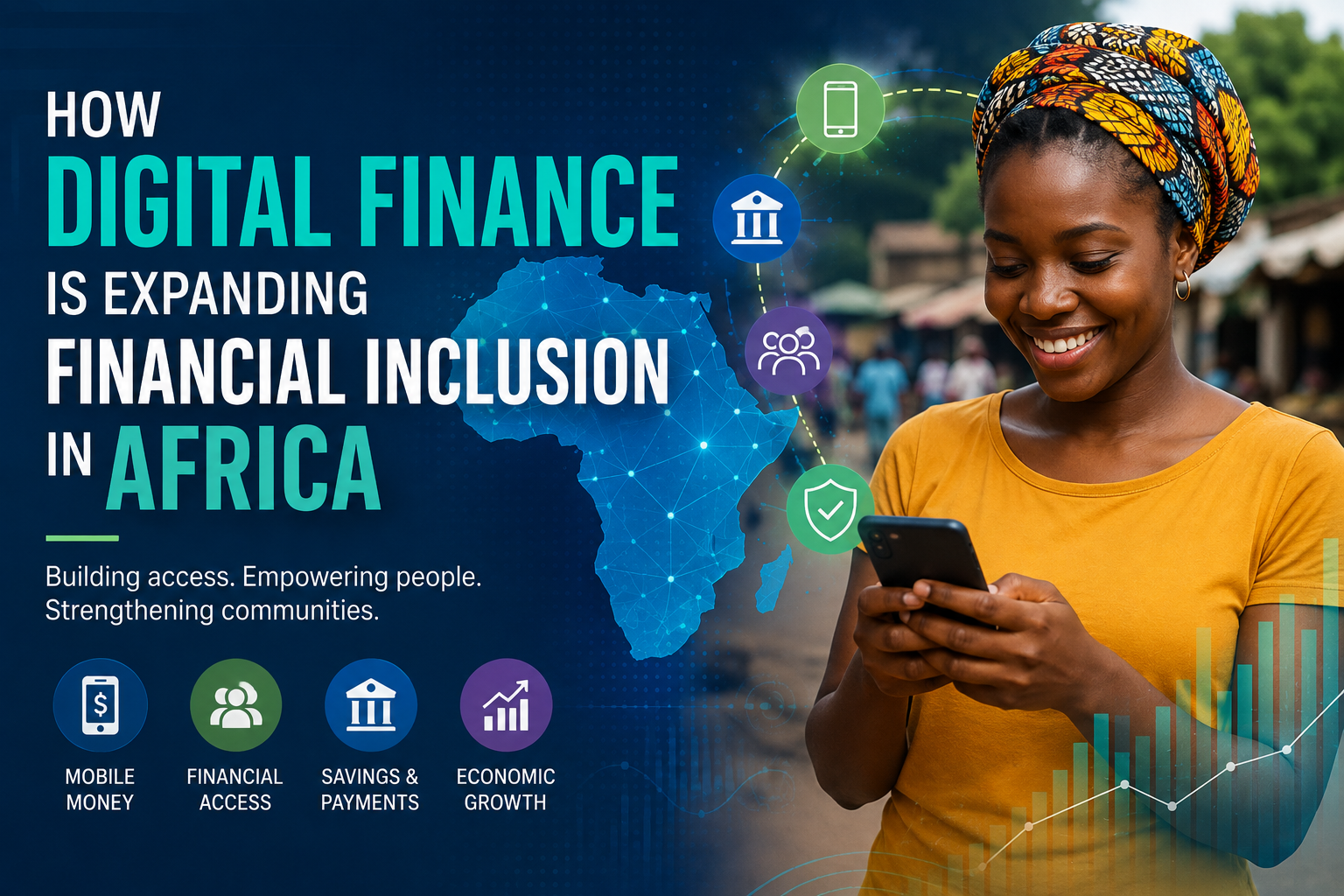
Digital finance is reshaping financial inclusion across Africa, with mobile money, fintech and digital payments helping more people access, use and benefit from essential financial services

On this page
Financial inclusion in Africa is no longer simply about building more bank branches.
Increasingly, it is about making financial services accessible through the devices people already use, the payment networks they already trust, and digital platforms that can reach communities beyond the traditional banking system.
That shift is already visible in the data. According to the World Bank's Global Findex 2025, account ownership in Sub-Saharan Africa reached 58% of adults in 2024, up from 49% in 2021. The increase has been driven substantially by the growth of mobile money, which has become one of the region's most important pathways into formal financial services.
But financial inclusion is not simply about opening an account. The bigger question is whether people can actually use financial services to receive money, make payments, save, borrow, manage risk and participate in the economy. Africa's digital-finance transformation is increasingly addressing that question.
Financial Inclusion Is Expanding, But Progress Is Uneven
The headline numbers are encouraging. Sub-Saharan Africa has made substantial progress in expanding access to financial accounts over the past decade. The latest World Bank data show that 58% of adults in the region had an account in 2024, compared with 49% in 2021.
But averages can hide enormous differences between countries. Kenya, for example, has developed one of the world's most mature mobile-money ecosystems, while other African countries still have relatively low levels of formal financial access.
The World Bank's regional analysis has previously shown account ownership ranging from single-digit levels in some countries to very high levels in markets such as Kenya and Mauritius.
That means there is no single African financial-inclusion story. Different countries face different barriers. In some markets, the problem is distance from financial institutions. In others, it is affordability. Elsewhere, people may lack identification documents, reliable connectivity, financial literacy or trust in formal institutions. Digital finance can help address some of these barriers—but it does not automatically eliminate all of them.
Mobile Money Has Become a Gateway to Financial Services
Few technologies have had a greater impact on African financial inclusion than mobile money. A mobile-money account can allow someone to store value, send money, receive payments and pay bills without maintaining a traditional bank account.
That distinction matters. For someone living far from a bank branch, a mobile phone can effectively become the access point to financial services. The GSMA's 2026 State of the Industry report found that mobile money processed more than $2 trillion in transactions globally during 2025, while registered accounts reached approximately 2.3 billion.
Sub-Saharan Africa remains the center of this ecosystem. GSMA data based on the latest Global Findex shows that 40% of adults in Sub-Saharan Africa had a mobile-money account in 2024, the highest regional rate in the world. Importantly, around 20% of adults had mobile money as their only financial account.
That second number tells us something important. For millions of people, mobile money is not simply an additional financial product. It is their primary connection to the formal financial system.
Financial Inclusion Is About Usage, Not Just Access
Having an account is only the first step. A financially included person should be able to use that account meaningfully. That could involve: Receiving wages → paying bills → saving → sending money → receiving remittances → accessing credit.
Digital finance makes many of these activities possible through a mobile device. The IMF's 2025 Financial Access Survey found that digital transactions—including mobile money and mobile and internet banking—in emerging and developing economies increased from 55 transactions per adult in 2017 to 251 transactions per adult in 2024.
The growth has been particularly significant in Sub-Saharan Africa, where mobile money has brought millions of people into the formal financial system without requiring a traditional bank account. That is an important change in the definition of banking. Financial participation no longer necessarily begins with a bank branch. It can begin with a phone.
Women Are Still Being Left Behind
Despite the progress, financial inclusion remains unequal. According to World Bank Gender Data, 52.3% of women in Sub-Saharan Africa had an account in 2024, compared with 64.4% of men, leaving a gender gap of approximately 12 percentage points.
This matters because financial access can affect much more than the ability to make payments. An account can provide a safer place to store money, make it easier to receive wages, facilitate savings and potentially improve access to other financial services.
Digital finance has helped narrow some financial-access gaps, but technology alone cannot eliminate them. Women may still face barriers involving income, identification, phone ownership, digital literacy, social norms and control over financial resources. The next stage of financial inclusion therefore needs to focus not only on whether women have accounts, but on how they use them.
Mobile Phones Are Becoming Financial Infrastructure
The relationship between mobile connectivity and financial inclusion is becoming increasingly important. The World Bank's Global Findex 2025 introduced globally comparable data on mobile-phone ownership, internet use and digital safety alongside financial-inclusion indicators. Globally, 86% of adults owned a mobile phone in 2024, including 68% who owned a smartphone.
That creates an enormous potential distribution network for financial services. A bank branch requires a physical location. A mobile application can potentially reach someone wherever there is connectivity.
But this also creates a new challenge. People need affordable connectivity and sufficiently capable devices to take full advantage of digital finance. A person may technically have access to a mobile network while still being excluded from more advanced digital financial services because of the cost of smartphones, data or electricity.
Digital Payments Can Bring People Into the Financial System
Payments are often the first financial service people use. Someone might open an account because an employer wants to pay them digitally. A farmer might receive payment electronically. A household might receive a government transfer into an account. A small business might begin accepting digital payments. Once the account exists, other financial services can potentially be built around it.
The World Bank describes payments as an important catalyst for account ownership. Its Global Findex analysis shows that receiving wages and government payments can be a major reason people open their first account.
This creates an important policy opportunity. Instead of asking: How do we persuade everyone to open a bank account?, policymakers and financial institutions can ask: How do we make everyday payments easier to receive digitally? The second approach can create a natural path into the financial system.
Digitalizing Agricultural Payments Could Be Significant
Agriculture provides a particularly interesting opportunity. Over 140 millions of African workers and farmers still receive payments in cash. The World Bank estimates that more than 80 million unbanked adults in Sub-Saharan Africa receive payments for agricultural goods in cash. The same research notes that around 45% of unbanked agricultural-payment recipients have a mobile phone, suggesting that digitalizing agricultural payments could help bring more people into formal financial services.
The potential is significant. A farmer who receives a digital payment can potentially: Receive payment → store funds → pay suppliers → save → build a transaction history without needing to travel to a bank branch simply to receive cash. The payment itself can become the entry point into broader financial participation.
Digital Finance Can Help Small Businesses Too
Financial inclusion is not only about individuals. Small businesses also need access to reliable financial services.
A merchant who can accept digital payments can potentially reduce dependence on cash. A business that keeps digital transaction records may have a clearer financial history. A small company can potentially use digital platforms to pay employees, suppliers and service providers. And as digital financial infrastructure becomes more sophisticated, businesses may gain access to additional services such as savings, credit, insurance and cross-border payments.
This is particularly important in economies where small and informal businesses account for a large share of economic activity. The challenge is ensuring that digital financial products are affordable enough for small businesses to actually use them.
Digital Savings Are Changing How People Store Money
Digital finance is also changing saving behavior. A person does not necessarily need to keep savings under a mattress or travel to a bank branch to deposit money. Mobile-money and digital accounts can provide alternative ways to store funds.
The World Bank notes that Sub-Saharan Africa has seen significant growth in account-based saving, with mobile money playing an important role in that transition.
This matters particularly for people whose income arrives irregularly. A farmer, freelancer, trader or small-business owner may receive money several times throughout a month. Digital financial services can make it easier to separate money for spending from money intended for future needs.
Access to Credit Is Still a Major Challenge
Financial inclusion also means access to responsible credit. Here, Africa's digital-finance story becomes more complicated.
Mobile-money transactions can create useful records of financial activity, but transaction history does not automatically mean someone should receive a loan. Digital lending has expanded rapidly in several African markets, but it has also raised concerns about affordability, consumer protection and over-indebtedness.
The IMF's Financial Access Survey notes that fintech lending is transforming credit access for underserved populations, but the expansion of digital credit also requires appropriate regulatory and consumer-protection frameworks.
The objective should therefore not be: More digital loans. It should be: Better access to appropriate financial services. That distinction is crucial.
Identification Remains an Important Barrier
Technology cannot solve every financial-inclusion problem. In some parts of Africa, people still lack the identification documents required to open formal financial accounts.
The World Bank's research on identification in Sub-Saharan Africa found that 78% of eligible people aged 15 and above had an ID across the 36 economies covered, but access varied considerably between countries. In some countries, more than 90% of adults have identification. In others, fewer than 60% do. That creates a fundamental problem.
If financial institutions need identification to onboard customers, people without recognized identification can remain excluded regardless of how advanced the payment technology becomes. Digital identity therefore needs to develop alongside digital finance.
The Digital Divide Can Become a Financial Divide
The expansion of digital finance creates another concern. People who lack smartphones, internet access, digital literacy or reliable electricity can struggle to participate. The World Bank's latest data show that 31% of adults without financial accounts in low- and middle-income economies also do not own a mobile phone, with the share particularly significant in Sub-Saharan Africa.
That means digitalization can create two outcomes simultaneously. It can reduce financial exclusion for people who gain access. But it can also leave behind people who cannot access the technology. Successful financial inclusion therefore requires a combination of: Financial infrastructure + connectivity + affordable devices + digital literacy + consumer protection.
Security Will Become Part of Financial Inclusion
As more people move their financial lives onto mobile devices, security becomes inseparable from inclusion. The World Bank's Global Findex 2025 found that while mobile-phone ownership is widespread, only around half of mobile-phone owners in low- and middle-income economies use a password to protect their phones.
That creates a new vulnerability. A person can be financially included on paper while remaining highly exposed to fraud, account takeover or unauthorized transactions. Digital financial inclusion therefore needs to include digital financial safety.
Users need: - Secure authentication - Fraud monitoring - Clear transaction alerts - Accessible customer support - Dispute-resolution mechanisms - Consumer education Convenience without security is not meaningful inclusion.
Remittances Are Becoming More Digital
Remittances are another area where digital finance can make a difference. Migrants sending money home have traditionally relied on cash-based agents and other physical channels.
Digital payment platforms can reduce some of the friction by allowing money to move electronically. The IMF's 2025 Financial Access Survey found that the share of digital remittance flows increased from 13% in 2019 to 46% in 2024.
That represents a substantial change in only five years. For recipient households, the ability to receive money directly into an account or mobile wallet can make funds easier to access and potentially easier to save or use for digital payments.
Financial Inclusion Is Becoming More Connected
The most interesting development may be that these services are beginning to converge. A single user can potentially have: Mobile money → bank account → digital wallet → savings → merchant payments → credit → remittances.
The boundaries between different financial products are becoming less obvious. This can create a more flexible financial ecosystem. Someone who starts with mobile money may eventually use a bank account. A small merchant who starts accepting payments may later use digital credit. A freelancer who receives international payments may begin saving digitally. The financial journey becomes continuous rather than divided into separate institutions.
What Africa Still Needs to Solve
Despite impressive progress, financial inclusion remains unfinished. Several barriers still deserve attention.
- Affordability — Financial services must be cheap enough for low-income users.
- Connectivity — Digital services require reliable networks and electricity.
- Identification — People need practical ways to establish financial identity.
- Security — Users need protection from fraud and unauthorized access.
- Financial literacy — People need to understand the products they are using.
- Consumer protection — Digital financial services need effective dispute and redress mechanisms.
- Gender equality — Women need equal access to accounts, phones and financial opportunities.
- Interoperability — Different payment systems need to communicate.
Solving these problems is not the responsibility of fintech companies alone. It requires cooperation between governments, regulators, banks, mobile operators, payment companies and technology providers.
The Future of Financial Inclusion May Be Digital, but It Must Also Be Human
Digital finance can dramatically expand access. But financial inclusion is ultimately about people. A mobile-money account means little if the user cannot afford the transaction fees. A digital wallet means little if the user cannot secure it. A bank account means little if there is no convenient way to use it. A digital loan means little if repayment terms push a household deeper into financial distress.
The objective should therefore not be simply to maximize the number of digital accounts. It should be to create a financial system that people can use safely, affordably and productively.
Africa Has Already Shown What Is Possible
The continent's mobile-money ecosystem has demonstrated that financial infrastructure does not always need to follow the traditional banking model.
Mobile phones have become payment instruments. Digital wallets have become financial accounts. Fintech companies have created new ways to access services. And payment networks are increasingly connecting different financial institutions.
The next stage is about making these systems more inclusive, interoperable and secure. The World Bank's latest Global Findex data show that Sub-Saharan Africa's account ownership has already reached 58%, up from 49% in 2021.
That is substantial progress. But it also means that roughly four in ten adults still do not have an account. There is therefore a huge amount of work left to do.
The Bottom Line
Africa's financial-inclusion story is increasingly a digital one. Mobile money has brought financial services to millions of people who were previously outside traditional banking systems. Digital payments are becoming more common. Smartphones are becoming financial access points. Fintech companies are creating new products around payments, savings and credit.
But technology is not the final destination. The real objective is to create a financial system in which more people can participate, save, transact, borrow responsibly and protect themselves against financial shocks.
The progress so far is significant. The opportunity ahead may be even larger. Africa does not simply need more digital financial accounts. It needs a digital financial system that works for the people who have historically been left out.