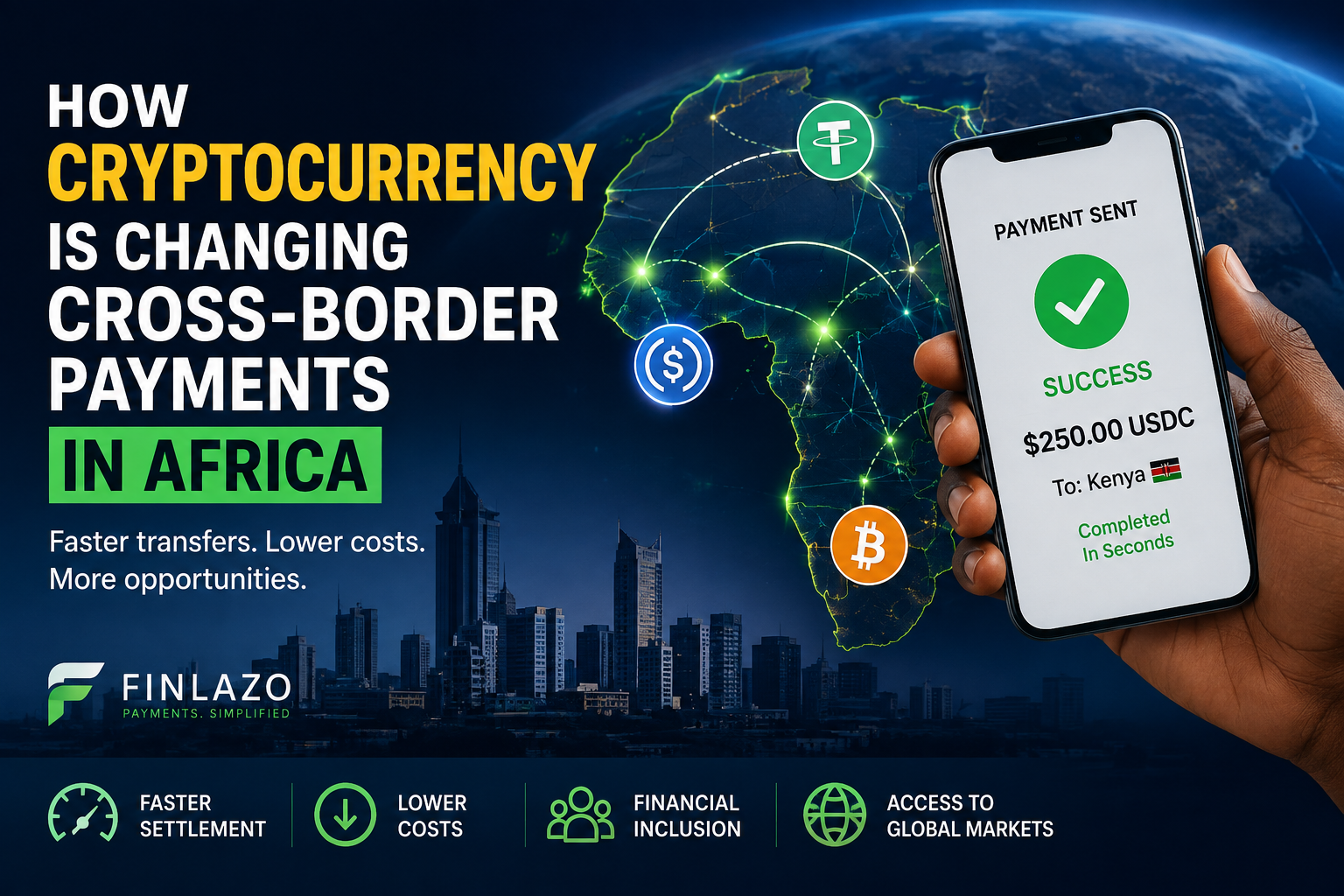
How Cryptocurrency Is Changing Cross-Border Payments in Africa
Cryptocurrency is reshaping cross-border payments in Africa by enabling faster digital settlement, supporting remittances, connecting mobile money with global markets, and creating new opportunities for businesses and individuals.

On this page
Africa's financial landscape is changing rapidly. Mobile money has already transformed how millions of people send and receive money. Digital banking has expanded access to financial services, while fintech companies have created new ways for businesses and individuals to move money.
Now, cryptocurrency is becoming another part of that transformation. For many people outside Africa, cryptocurrency is still primarily associated with investing and trading. Across African markets, however, digital assets are increasingly being used for practical financial purposes—including cross-border transfers, remittances, international trade, savings, and access to dollar-denominated value.
The change is particularly visible in Sub-Saharan Africa. According to Chainalysis, the region received more than $205 billion in on-chain cryptocurrency value between July 2024 and June 2025, representing approximately 52% year-over-year growth. Nigeria, Ethiopia, Kenya, South Africa, and Ghana were among the region's largest crypto markets during the period.
The numbers suggest that cryptocurrency is becoming more than an investment product. It is increasingly becoming part of the infrastructure people use to move and manage value.
Why Cross-Border Payments Matter in Africa
Africa is made up of dozens of economies, currencies, banking systems, and regulatory environments. While a business operating in Kenya may need to pay a supplier in Ghana, a freelancer in Nigeria may work for a company in Finland. A family in the United States may send money to relatives in Uganda. A Nigerian company may need to pay an international technology provider.
Each transaction crosses a financial border. Traditional systems can handle these payments, but the process may involve correspondent banks, foreign-exchange conversions, intermediary institutions, settlement windows, and multiple fees.
This creates friction. The World Bank has consistently documented the relatively high cost of remittances to Sub-Saharan Africa, while the IMF's 2026 analysis of Nigeria describes stablecoins as an increasingly meaningful alternative channel for cross-border transfers. Cryptocurrency has introduced another way to move value across those borders.
Cryptocurrency Provides a Digital Settlement Layer
A cross-border payment does not necessarily need to remain in cryptocurrency from beginning to end. A simplified transaction could look like: Sender's local currency → Digital payment provider → Cryptocurrency or stablecoin settlement → Local conversion → Recipient's local currency → Bank account or mobile-money wallet. The recipient may never interact directly with a blockchain.
The cryptocurrency can simply act as the bridge between two financial systems. This is particularly important for stablecoins, which are designed to maintain a relatively stable value and are commonly denominated in U.S. dollars.
Stablecoins Are Driving Much of the Payment Use Case
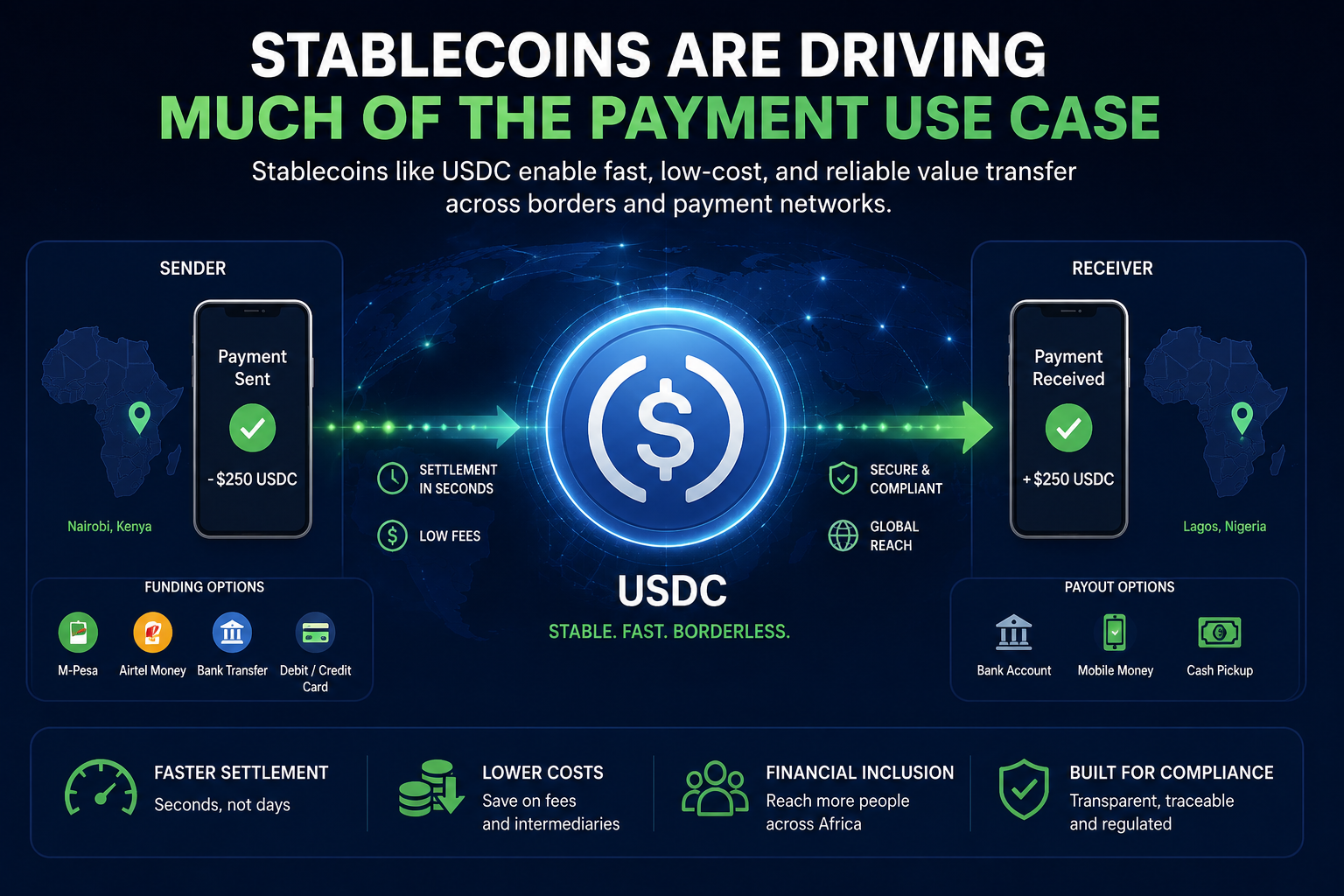
Not every cryptocurrency is equally suited to payments. Bitcoin, for example, can be used to transfer value but its price volatility makes it difficult to use as a predictable settlement asset for many businesses. Stablecoins address part of that problem by maintaining a value linked to an underlying asset, most commonly the U.S. dollar.
Chainalysis Geography of Crypto Report has found that stablecoins play a significant role in Sub-Saharan Africa's crypto economy, particularly in high-value transactions associated with trade and cross-border activity. Its 2025 research identified regular multi-million-dollar stablecoin transfers supporting areas such as energy and merchant payments. This represents an important shift. Crypto infrastructure is increasingly being used not only to buy and sell digital assets, but also to move real economic value.
Nigeria Shows How Crypto Can Solve a Real Payment Problem
Nigeria provides one of the clearest examples. Chainalysis reported that Nigeria received more than $92.1 billion in cryptocurrency value between July 2024 and June 2025, making it by far the largest crypto market in Sub-Saharan Africa during that period.
The IMF has also identified Nigeria as a particularly important stablecoin market. According to the IMF, Nigeria received approximately $59 billion in crypto-asset inflows between July 2023 and June 2024 and accounted for roughly 60% of stablecoin activity measured across Sub-Saharan Africa during that period.
Why is this happening? Part of the answer is the difficulty of accessing foreign currency and moving money internationally through traditional channels. For Nigerian households and small businesses, dollar-denominated stablecoins can provide another mechanism for moving value across borders. The IMF describes stablecoins as a growing cross-border channel in Nigeria, with households and businesses increasingly using smartphones, digital wallets, and dollar-pegged digital assets for international transfers.
Remittances Are a Major Use Case
Remittances are one of the clearest areas where cryptocurrency can potentially improve the movement of money. Remittances affect an enormous share of the global population. Around one billion people are directly connected to remittance flows, with roughly 200 million migrants and overseas workers sending money home each year.
Those transfers support an estimated 800 million family members, while migrants and diaspora communities have sent nearly US$5 trillion to their home countries over the past decade. Traditional remittance systems remain important, but sending money internationally can be expensive, particularly when the transaction involves multiple currencies and intermediaries.
Stablecoins can potentially reduce some of that friction by allowing value to move across a blockchain before being converted into local currency. Chainalysis has previously estimated that the average cost of sending a $200 remittance from Sub-Saharan Africa could be substantially lower when using stablecoins than through traditional fiat-based channels.
The important point is not that blockchain automatically makes every payment cheaper. The final cost still depends on:
- Foreign-exchange conversion
- Blockchain fees
- Payment-provider charges
- Compliance requirements
- Liquidity
- Local payout costs
But cryptocurrency introduces another settlement option that can compete with traditional payment infrastructure.
Freelancers and Remote Workers
Cross-border payments are also changing for individuals who work internationally. Africa has a growing population of freelancers, software developers, designers, consultants, online entrepreneurs, and remote workers serving customers outside their home countries.
A 2018 Payoneer survey estimated that professionals based in Africa accounted for around 10.1% of freelancers globally, highlighting the continent's growing participation in the international digital workforce. Receiving international payments can be difficult when the worker does not have access to convenient international banking infrastructure.
Cryptocurrency can provide another way to receive value. A client in the United States, Europe, or Asia can send a digital asset to a wallet, after which the recipient can potentially convert it into local currency through an appropriate regulated service like Finlazo. Again, the cryptocurrency does not have to become the recipient's permanent form of money. It can simply be the settlement mechanism.
Businesses Are Using Crypto for International Trade
The opportunity goes beyond individuals. Businesses operating across borders need to pay suppliers, contractors, logistics providers, technology companies, and other partners. This can create working-capital challenges when international transfers take time to settle.
Chainalysis' 2025 research found evidence of substantial stablecoin transfers associated with trade flows between Africa, the Middle East, and Asia. The firm identified regular multi-million-dollar transactions supporting sectors including energy and merchant payments.
That suggests a broader role for crypto infrastructure. Instead of thinking about cryptocurrency purely as an asset that someone buys and sells, it can also be viewed as a settlement rail for international commerce.
Cryptocurrency Can Connect Mobile Money and Global Payments
One of Africa's biggest financial innovations is mobile money. Services such as M-Pesa have demonstrated that consumers can conduct financial transactions using mobile phones without relying exclusively on traditional bank branches. The next stage could involve connecting this local infrastructure to global digital settlement networks.
Imagine: U.S. dollars → Digital payment provider → Stablecoin → African settlement provider → Kenyan shillings → M-Pesa. The user could experience this as a normal money transfer. The blockchain infrastructure operates behind the scenes.This combination of local payment networks and global digital settlement could become one of the most important developments in African fintech.
Kenya Is Part of the Growth Story
Kenya is already one of Sub-Saharan Africa's major cryptocurrency markets. Chainalysis included Kenya among the region's five largest markets by cryptocurrency value received between July 2024 and June 2025.
That is particularly interesting because Kenya already has a mature mobile-money ecosystem. The country therefore has two important ingredients for digital financial innovation: A highly developed mobile-payment culture and Growing participation in digital assets. The long-term opportunity may be connecting these ecosystems rather than forcing users to choose between them.
Africa's Crypto Market Is Becoming More Institutional
The evolution is not limited to retail users. Financial institutions, fintech companies, payment providers, and digital-asset businesses are increasingly exploring cryptocurrency infrastructure.
South Africa provides an important example. Its regulatory framework has brought crypto-asset service providers into a more formal licensing environment, creating greater clarity for institutional participants. Chainalysis describes South Africa as having one of the region's more mature regulatory environments for crypto assets.
Meanwhile, Nigeria is moving toward a more structured regulatory approach while continuing to experience substantial crypto activity. This combination of adoption and regulation could eventually move cryptocurrency further into mainstream financial infrastructure.
Regulation Will Shape the Next Phase
Cryptocurrency can make the movement of value more efficient, but efficiency does not remove the need for regulation. Cross-border financial services involve important obligations relating to:
- Know Your Customer requirements
- Anti-money-laundering controls
- Sanctions screening
- Transaction monitoring
- Consumer protection
- Foreign exchange
- Licensing
- Taxation
- Data protection
These requirements become even more important when cryptocurrency is used as part of a payment service. African regulators are increasingly focusing on how crypto and stablecoins interact with existing financial systems.
Chainalysis noted in its 2025 regulatory review that authorities across key African markets are paying greater attention to stablecoins, cross-border trade, payment corridors, transaction monitoring, and FATF-aligned compliance requirements. The companies most likely to succeed will therefore be those that combine technological efficiency with strong compliance infrastructure.
Cryptocurrency Does Not Have to Replace Traditional Finance

The biggest misconception about crypto payments is that blockchain technology must replace banks. That is unlikely to be the most practical outcome. Instead, the future may be a hybrid financial system.
Banks can continue providing accounts. Mobile-money providers can continue serving consumers. Fintech companies can continue providing local payment services. Regulated crypto providers can provide digital-asset infrastructure. Blockchain networks can provide settlement. Stablecoins can connect currencies and financial systems. Each component performs a different function.
The result could be a financial ecosystem where the user experience remains familiar while the underlying infrastructure becomes faster and more interconnected.
The Biggest Opportunity May Be Behind the Scenes
Consumers do not necessarily care whether their payment traveled through a blockchain.
- 1. They care whether:
- 2. It arrives quickly.
- 3. It costs less.
- 4. It is reliable.
- 5. It is secure.
- 6. They can receive it in their preferred currency.
That is why the most successful crypto payment products may not look like cryptocurrency products at all.The blockchain could disappear into the infrastructure. A customer could send dollars. A business could receive Kenyan shillings. A freelancer could receive payment from Europe. A supplier could be paid in another African market. The underlying settlement layer could use cryptocurrency without requiring users to become crypto experts.
What Comes Next for African Crypto Payments?
Sub-Saharan Africa's cryptocurrency market is still developing, but the direction is becoming clearer. Chainalysis recorded more than $205 billion in on-chain value across the region in the year ending June 2025, while Nigeria alone accounted for more than $92 billion.
The IMF's 2026 analysis of Nigeria shows that stablecoins are already being used as a meaningful cross-border payment channel. The next stage will be about turning that existing activity into better financial infrastructure.
That means connecting: Cryptocurrency + local currencies, Stablecoins + mobile money, Blockchain + banking, Digital assets + regulated payment providers, African businesses + global markets. The opportunity is not simply to create more ways to buy cryptocurrency. It is to make moving value across borders easier.
The Bottom Line
Cryptocurrency is changing African cross-border payments because it offers something traditional financial systems have often struggled to provide: a global, digital settlement layer that can operate continuously across borders. Stablecoins are currently leading much of this practical use because they combine blockchain-based transfers with relatively stable, dollar-denominated value.
But cryptocurrency alone is not the solution. The strongest payment systems will combine blockchain infrastructure with local currencies, banks, mobile-money networks, regulated payment providers, liquidity, and compliance. Africa has already demonstrated that it can leapfrog traditional financial infrastructure. The next leap may be connecting its local payment networks to a global digital settlement layer.
The future of African payments may not be crypto replacing traditional finance. It may be crypto becoming part of the infrastructure that connects it.