The Future of Digital Payments in Africa: From Mobile Money to Stablecoins
Africa's digital payments are evolving from mobile money to interconnected fintech, instant-payment, and stablecoin networks. Explore how these technologies could work together to create faster, more accessible, and connected financial infrastructure across the continent.

On this page
Africa's payment landscape has changed dramatically over the past two decades. For millions of people, the mobile phone has become more than a communication device. It is a wallet, a payment terminal, a way to receive income, a channel for sending money to family, and increasingly a gateway to broader financial services.
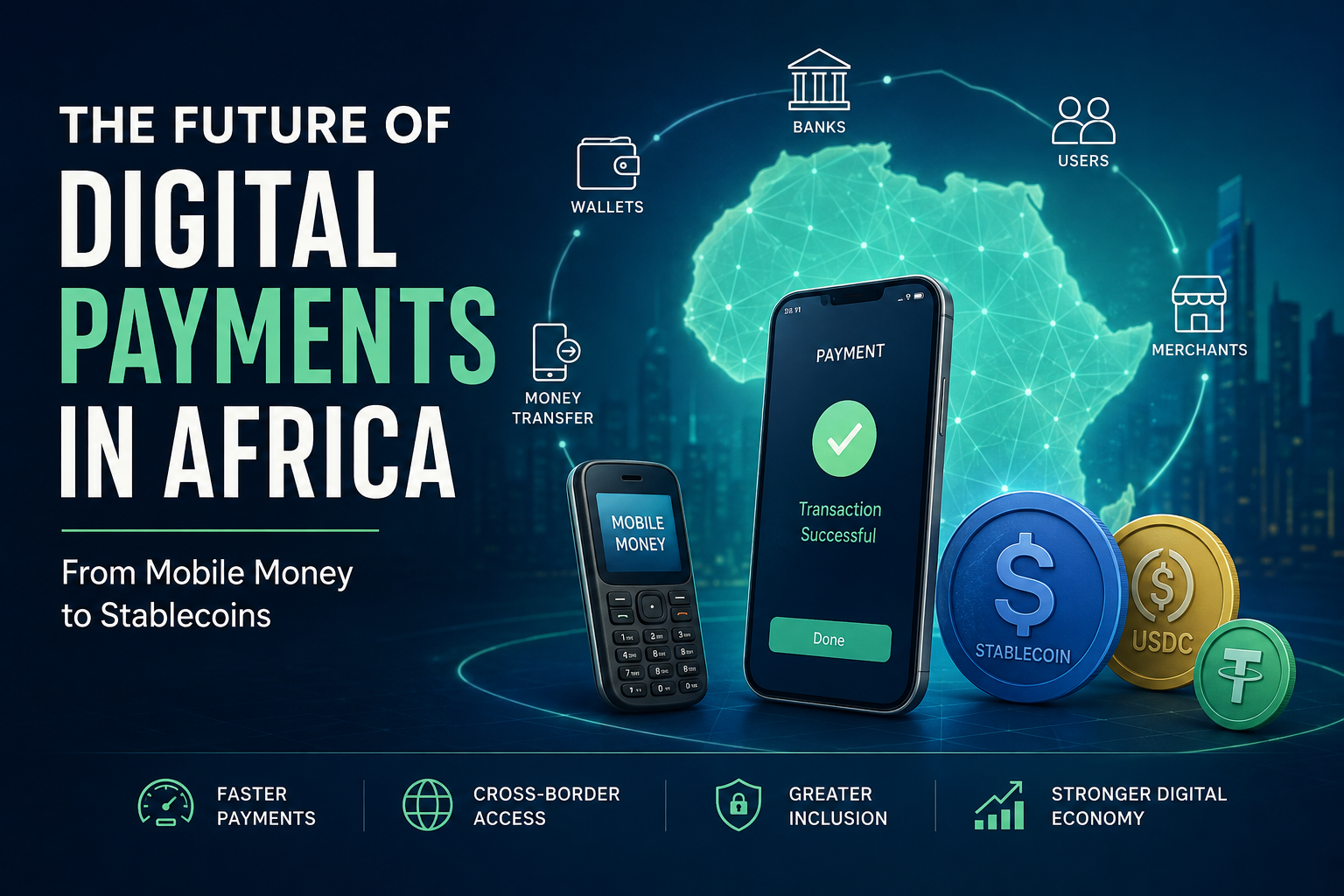
Mobile money helped establish this transformation. The next stage could be even more interconnected. Digital wallets, instant payment systems, fintech platforms, bank accounts, mobile money and stablecoins are increasingly becoming parts of the same financial ecosystem. Rather than replacing one another, these technologies can potentially work together to make payments faster, more accessible and more connected across borders.
The scale of the opportunity is already enormous. According to the GSMA's 2026 State of the Industry Report on Mobile Money, more than $2 trillion flowed through mobile money globally in 2025, while the number of registered mobile-money accounts reached 2.3 billion. The ecosystem also recorded 593 million active 30-day accounts.
For Africa, this matters because the continent has been at the center of the mobile-money revolution.
Africa Has Already Shown How Payments Can Leapfrog
Traditional financial infrastructure has not always reached every African consumer or business. Bank branches can be expensive to operate. Opening and maintaining bank accounts can involve requirements that are difficult for some populations. Physical cash remains important, particularly in areas where financial infrastructure is limited.
Mobile money changed the equation. Instead of requiring a customer to begin with a traditional bank account, a mobile phone could become the starting point for participating in the financial system. This was more than a technological development. It was an infrastructure leap.
GSMA data shows just how significant that leap has become. In Sub-Saharan Africa, more than 1.1 billion registered mobile-money accounts processed approximately $1.1 trillion in transactions during 2024, representing nearly 65% of global mobile-money transaction value.
The result is an ecosystem that already connects consumers, merchants, businesses and financial-service providers at enormous scale. The question now is what happens when that ecosystem becomes increasingly interoperable with other digital financial networks.
Mobile Money Is Becoming More Than a Wallet
The original mobile-money proposition was relatively simple: Send money. Today, the ecosystem is much broader. Mobile-money services increasingly support merchant payments, bill payments, savings, credit, insurance, business payments and international transfers. GSMA reported that merchant payments grew by almost half in 2025 to $155 billion, making it the fastest-growing mobile-money use case during the year.
This evolution is important because it shows that digital payment infrastructure becomes more valuable as additional services are built on top of it. A mobile wallet can become a financial platform. A payment network can become infrastructure for businesses. And a digital account can become the gateway through which people access multiple financial products.
The Smartphone Is Becoming a Financial Gateway
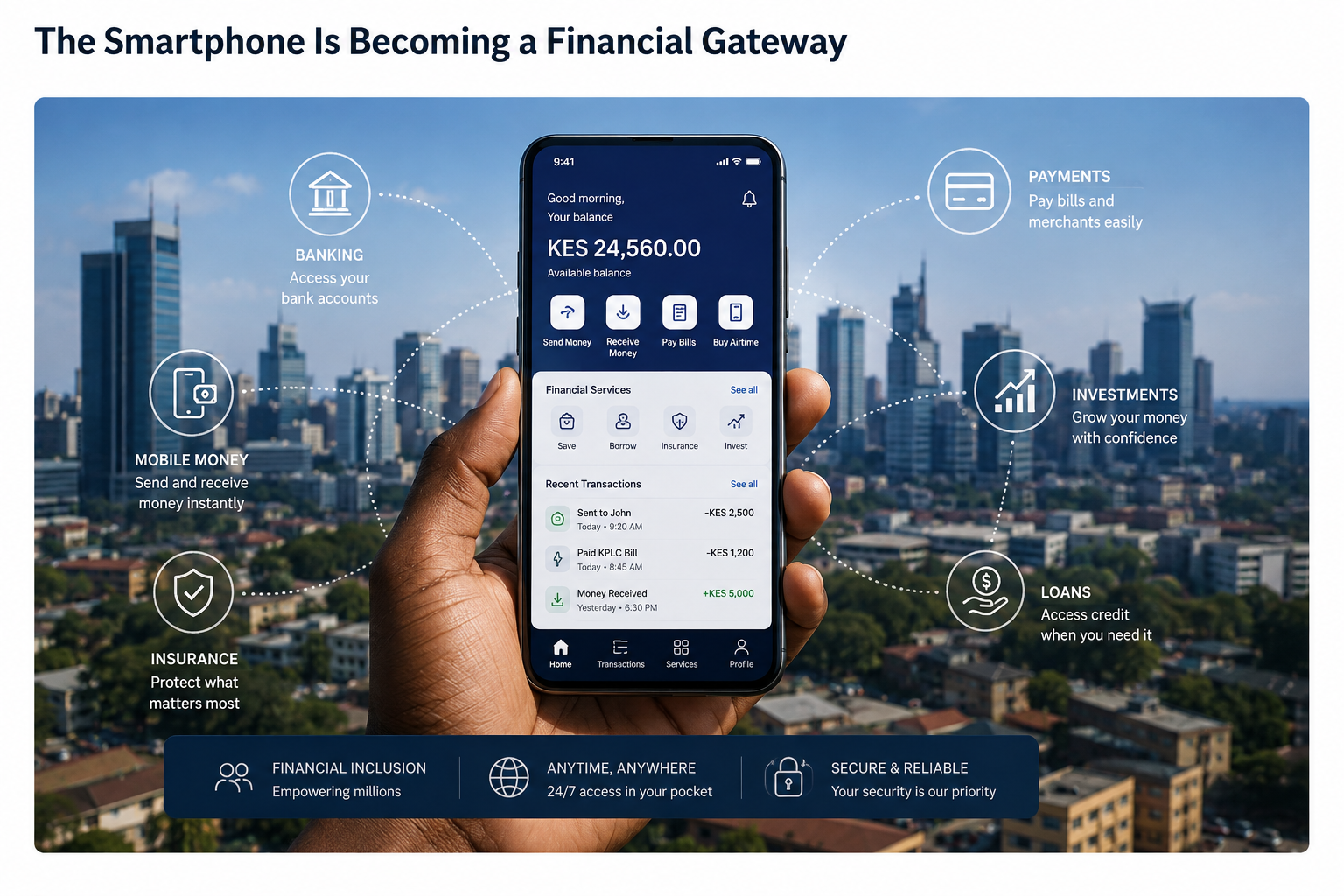
The expansion of mobile payments is happening alongside broader growth in digital connectivity. The World Bank's Global Findex 2025, based on nationally representative surveys covering about 148,000 adults across 141 economies, examines not only financial accounts and digital payments but also mobile-phone ownership, internet use and digital safety.
That combination matters. A person who has a mobile phone and access to the internet can potentially interact with financial services without ever visiting a physical branch. They can:
- Receive money
- Pay merchants
- Save
- Borrow
- Buy goods online
- Receive international payments
- Manage a business
- Access digital financial products
The financial system is gradually moving from physical locations toward digital interfaces.
Instant Payments Are the Next Layer
Mobile money is only one part of the transformation. Across Africa, payment infrastructure is increasingly moving toward faster and more interoperable systems. The long-term objective is not simply to make individual payments digital. It is to make different payment systems communicate with one another.
This is where interoperability becomes important. Imagine a future in which a customer can send money from one African country to another without needing to understand which bank, mobile-money provider or payment network sits behind the transaction. The technology underneath could be complicated. The customer experience should not be.
African Development Bank research increasingly treats digital payments as a core component of digital public infrastructure, alongside digital identity, interoperable systems and secure data exchange. That points toward a broader vision of digital finance: payment infrastructure that is connected rather than fragmented.
Stablecoins Add a Global Settlement Layer
This is where stablecoins become particularly interesting. Mobile money is excellent at moving local currency within an established payment ecosystem. But cross-border payments introduce another challenge. Different countries have different currencies. Different banks operate different systems. Foreign-exchange markets have to be accessed. Liquidity has to move between jurisdictions. Settlement can involve multiple intermediaries.
Stablecoins can potentially provide another layer between these systems. A simplified payment might look like: Sender's local currency → Local payment provider → Stablecoin settlement → Recipient-side payment provider → Local currency → Bank account or mobile-money wallet. The customer may never hold a stablecoin directly. The stablecoin can instead function as a settlement asset between financial institutions and payment providers.
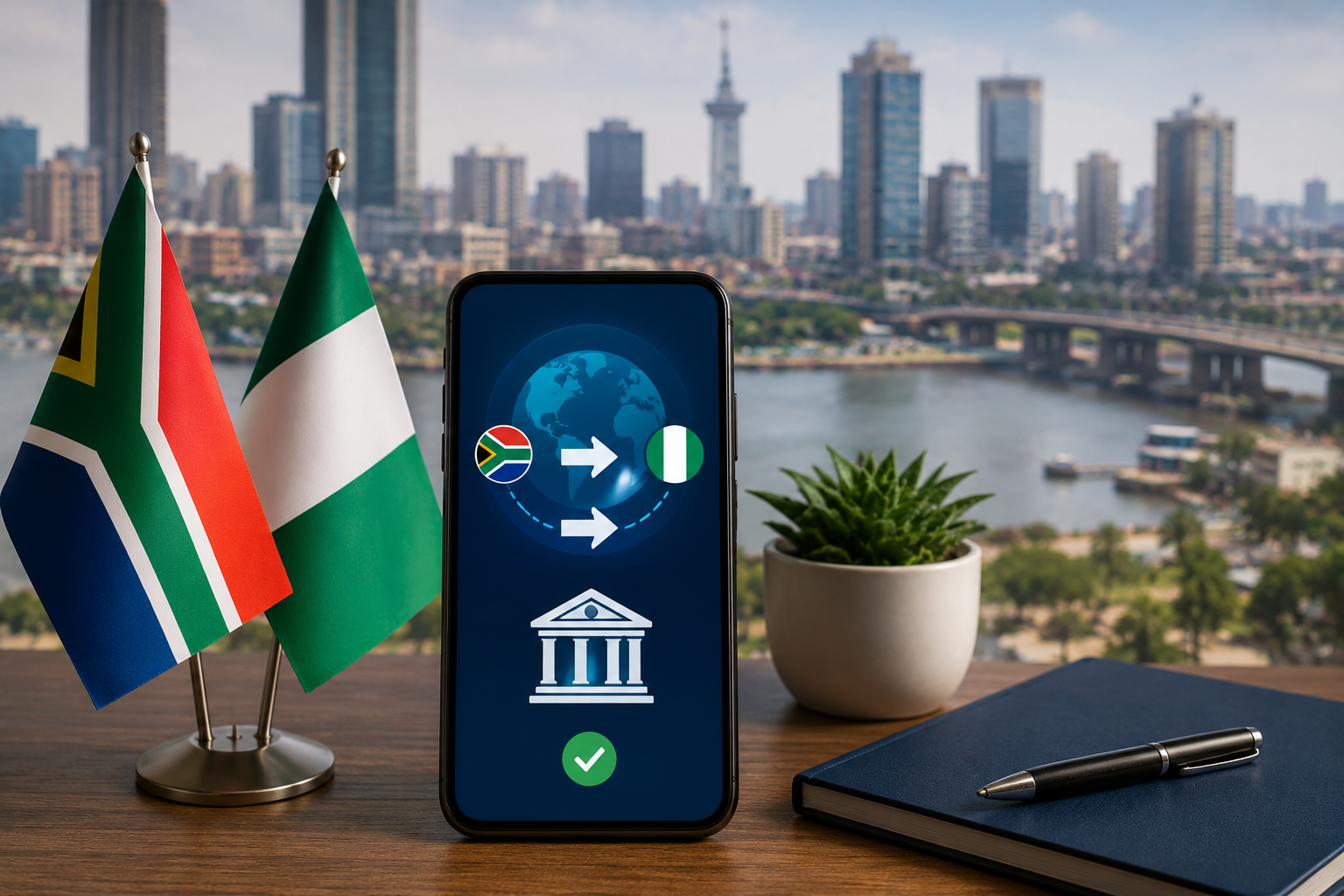
This is one reason stablecoins are attracting increasing attention in African payments. The International Monetary Fund's 2026 analysis of Nigeria found that stablecoins are becoming a meaningful channel for cross-border transfers, with Nigerian users increasingly turning to dollar-pegged digital assets for international payments.
The Future May Be a Combination of Systems
It is tempting to describe financial innovation as a competition: Banks versus fintechs. Mobile money versus cryptocurrency. Traditional payments versus blockchain. But that may be the wrong way to think about the future.
The more likely outcome is integration. A customer might use a mobile wallet. A merchant might use a bank account. A fintech might provide the payment interface. A stablecoin might provide cross-border settlement. A blockchain network might provide the underlying transaction layer. A regulated financial institution might handle custody, compliance or fiat settlement. Each system performs a different job. The customer simply experiences a payment.
Mobile Money and Stablecoins Can Complement Each Other
Consider a business in Kenya that needs to pay a supplier in another African country. The Kenyan business may prefer to fund the transaction using local currency. The supplier may ultimately want to receive local currency. Neither business necessarily wants to manage cryptocurrency.
Yet a stablecoin could potentially be used between the two payment providers as the settlement mechanism. The flow could be: Kenyan shillings → stablecoin → local currency. The blockchain sits in the middle. The customer experience remains familiar. This model could become particularly valuable as African businesses increasingly operate across borders.
Cross-Border Commerce Is Creating New Requirements
African businesses are no longer limited to selling within their immediate geographic markets. An online company can sell software to customers in Europe. A freelancer can work for a company in North America. An importer can purchase products from Asia. An African technology company can employ workers across several countries. All of these activities create payment requirements.
Businesses need to receive international revenue, pay suppliers, manage foreign exchange, and move working capital. Traditional financial systems remain essential, but digital payment infrastructure can potentially make these activities more efficient.
The opportunity is therefore much larger than consumer payments. It includes the entire digital economy.
Remittances Could Benefit From Better Connectivity
Remittances are another area where different payment technologies could converge. A migrant worker might send money from a bank account or digital wallet in one country. The payment provider could use a digital settlement network to move value internationally. The recipient could receive local currency through a bank account or mobile-money wallet. Again, the customer does not need to understand the infrastructure underneath the transaction.
The important outcome is that the money arrives safely, quickly and at a reasonable cost. This is particularly relevant in Africa, where remittance costs remain a major challenge. Stablecoins could potentially reduce some settlement friction, but they are only one part of the equation. Foreign-exchange conversion, compliance, liquidity and local payout infrastructure still determine the final cost and experience.
Digital Payments Can Expand Financial Inclusion
The significance of digital payments extends beyond convenience. They can create pathways into the formal financial system. The World Bank's Global Findex 2025 highlights the relationship between digital connectivity and financial inclusion, while its Sub-Saharan Africa research shows the expanding role of mobile money in payments, savings and borrowing.
Digital payments can create transaction histories. They can allow businesses to accept payments without physical cash. They can make it easier to distribute salaries, government transfers and other forms of income. They can also connect previously underserved consumers to additional financial products. This is why digital payments are increasingly viewed as infrastructure rather than simply a consumer convenience.
Businesses Are Becoming Digital Payment Users Too
The transformation is not happening only among consumers. Mobile money is increasingly being integrated into business operations. GSMA's Africa-focused research highlights uses including merchant payments, digital payroll, working-capital management and supply-chain financing.
That matters for small and medium-sized businesses. A retailer can receive payments digitally. A farmer can be paid through a mobile wallet. A company can pay employees electronically. A supplier can receive funds without handling physical cash. As more business activity moves into digital payment networks, the demand for interoperability becomes greater. Businesses don't want ten disconnected financial systems. They want one payment experience that works across their markets.
Regulation Will Shape the Next Generation of Payments
Technology alone will not determine the future of African digital finance. Regulation will play an equally important role. Payment providers need to address:
- Customer identification
- Anti-money-laundering requirements
- Fraud prevention
- Consumer protection
- Data security
- Licensing
- Foreign exchange
- Digital-asset regulation
- Cross-border compliance
This becomes particularly important when different technologies interact.
A payment that begins as fiat, moves through a digital asset and ends as mobile money may involve multiple regulated entities across several jurisdictions. The regulatory framework therefore needs to keep pace with the technology.
African Development Bank initiatives are already supporting the development of digital-payment infrastructure and financial inclusion. In 2026, for example, the Bank supported an electronic-payments initiative in Morocco aimed at expanding digital payments and reducing reliance on cash.
The direction is clear: digital payments are increasingly becoming part of national financial infrastructure.
Security and Trust Will Matter More Than Ever
Greater digital adoption also creates greater responsibility. A financial system that moves billions of dollars digitally must be secure. Fraud prevention, identity verification, cybersecurity and consumer protection cannot be treated as secondary features.
GSMA's latest mobile-money research specifically identifies fraud and consumer protection as continuing challenges as the industry expands. The next generation of payment companies therefore has to solve two problems simultaneously: - Make payments easier. - Make payments safer. Convenience without trust will not create sustainable financial infrastructure.
Africa Could Build a Connected Digital Payment Ecosystem
Africa does not need to copy the financial infrastructure of another continent. It already has something unique. It has demonstrated that mobile-first financial services can scale rapidly. Mobile money has become deeply embedded in everyday economic activity.
Fintech companies are building new financial products on top of that infrastructure. Instant-payment systems are developing. Digital identity and other components of digital public infrastructure are expanding. And blockchain-based settlement technologies are introducing new ways to move value internationally. The opportunity is to connect these layers.
Imagine a financial ecosystem where: Mobile money handles local access. Banks provide traditional financial services. Fintechs provide digital experiences. Instant-payment networks connect domestic markets. Stablecoins provide global digital settlement. Blockchain provides programmable infrastructure. Regulated institutions provide trust and compliance.
That is a very different vision from cryptocurrency replacing the banking system. It is a vision of different technologies working together.
What the Next Decade Could Look Like
The most important developments in African payments may not come from a single technology. They may come from interoperability. A consumer should not have to know whether a transaction moved through a bank, mobile-money network, instant-payment system or blockchain. A business should not need separate financial infrastructure for every country in which it operates.
The technology should increasingly disappear behind the experience. This is what happened with the internet. People don't think about packets, servers and routing when they send a message. They simply communicate. Payments could eventually work the same way. The underlying systems may become more sophisticated while the user experience becomes simpler.
The Future Is Digital—and Increasingly Connected
Africa's payment revolution did not begin with cryptocurrency. It began with the mobile phone. Mobile money demonstrated that financial services could leapfrog traditional infrastructure and reach people through technology they already had. The next phase could connect that local digital infrastructure to global financial networks.
Stablecoins may become part of that bridge. Instant-payment systems may connect domestic markets. Fintech platforms may make the experience easier. Banks may provide regulated financial infrastructure. Blockchain networks may provide new settlement capabilities. And mobile money may continue serving as one of the most important access points for everyday users. The result could be a financial system that is more connected than the one that came before it.
Bottom Line
Africa's digital-payment future is unlikely to belong to one technology. It will belong to connected technologies. Mobile money has already demonstrated the power of digital financial infrastructure at enormous scale. With more than $2 trillion processed globally in 2025, the sector has moved far beyond its original role as a simple money-transfer tool.
The next opportunity is to connect that infrastructure with banks, fintech platforms, instant-payment networks and emerging blockchain-based settlement systems. Stablecoins could become one part of that architecture, particularly for cross-border transactions. But the bigger story is interoperability. Africa's next payment revolution may not be about replacing the systems that already work. It may be about connecting them.