Marketplace payout infrastructure · Africa

Pay sellers and freelancers across Africa

Pay sellers and freelancers through eligible African bank accounts, mobile money or stablecoin wallets. Connect funding, settlement, local payouts and reconciliation through Finlazo.

Business onboarding, funding methods, payout routes and beneficiary eligibility depend on approval.

One marketplace · Multiple ways to pay

From your business balance to a seller's receipt.

Illustrative payout flow

Local-currency payout

Seller receives bank or mobile-money credit

Marketplace → local money

Marketplace funding

Approved business balance and seller reference

Instruction

Finlazo infrastructure

Payout · conversion · status

Local payout

Bank or mobile money

Confirmed beneficiary credit

Stablecoin wallet payout

Seller receives an eligible digital asset

Marketplace → USDC / USDT

Marketplace funding

Approved business balance and seller reference

Instruction

Finlazo infrastructure

Verification · transfer · status

Wallet transfer

Seller crypto wallet

Supported asset and network

Mobile money Bank accounts Stablecoin wallets
See how it works
Example architecture only. Funding, beneficiary eligibility, payout direction, available methods, quotes and final delivery depend on approved market routes.

Built for marketplaces and payment-led businesses

  • Marketplaces
  • Freelancer platforms
  • Gig economy
  • Creator platforms
  • Payroll products
  • Payment platforms

Africa's payment infrastructure · GSMA data

The local payment rails are already operating at scale.

The scale of mobile money helps explain why marketplaces need payout routes built around how African sellers already receive money.

$1.4 trillion

Value of mobile money transactions in Sub-Saharan Africa in 2025, reported by GSMA in 2026.

92 billion

Mobile money transactions in Sub-Saharan Africa in 2025, from the same GSMA research.

These are industry-wide mobile money figures, not marketplace payout totals or Finlazo transaction volumes.

Why Finlazo

Stablecoin settlement meets African local delivery.

Your finance team needs more than a transfer. Connect seller references, approved funding and actual payout receipts across your markets.

Flexible seller delivery

Pay eligible sellers through supported bank and mobile-money routes or compatible stablecoin wallets.

Connected infrastructure

Bring business funding, conversion, digital-asset settlement and local delivery into a coherent payout journey.

Payout visibility

Assign each seller a payment reference and track pending, successful and returned payout activity.

Reconciliation-first design

Connect finance records with settlement references, delivery status, fees and final seller receipt.

From instruction to receipt

How payouts to sellers and freelancers work.

A simple operational path: agree on the route, fund your marketplace, and reconcile the seller's actual receipt.

  1. 01

    Confirm the payout route

    Verify the marketplace, funding source, destination markets, beneficiary types and expected payout volume.

  2. 02

    Fund and instruct

    Fund the approved business balance, calculate what each seller is owed and submit the eligible payout instructions.

  3. 03

    Deliver and reconcile

    For wallet payouts, reconcile the confirmed transfer. For local money, confirm the bank or mobile-money credit.

Marketplace payout tools

Your business dashboard and payout integrations.

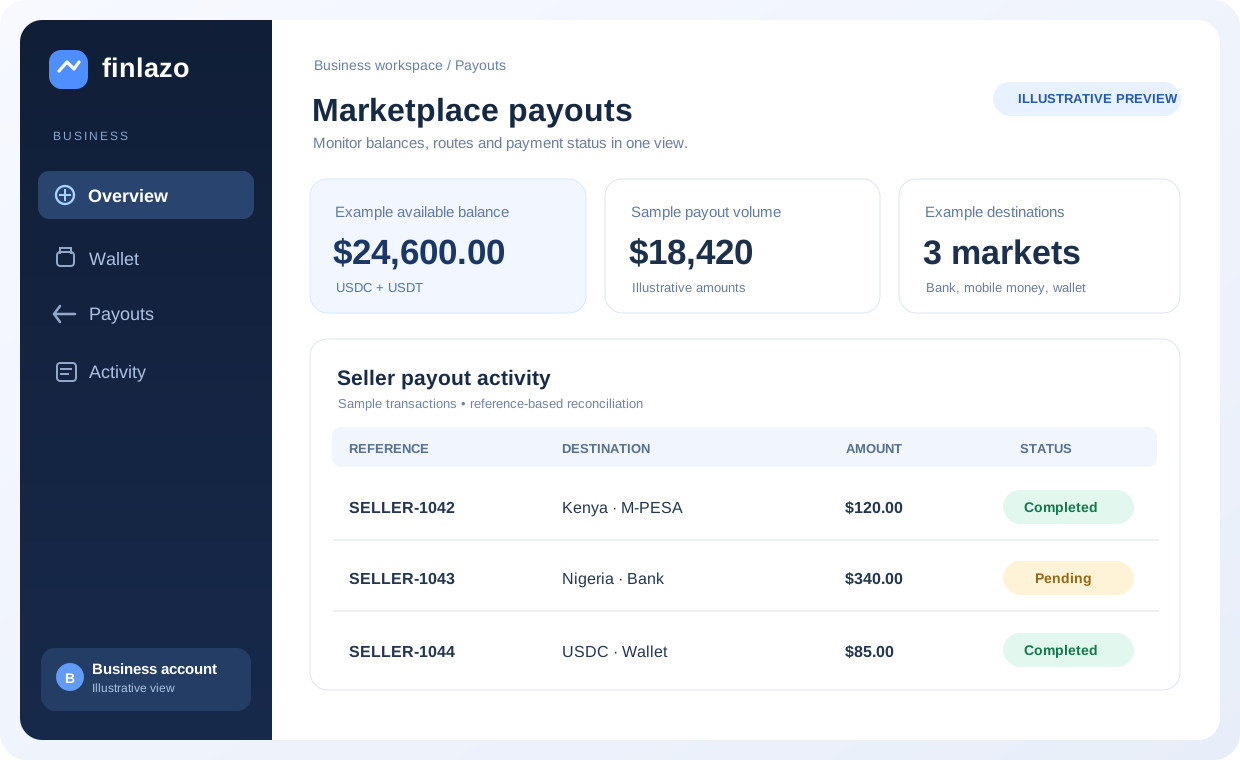
See your business balances and wallet activity. For marketplace payouts, configure the eligible destinations, seller references, status reporting and finance-team workflows for your approved integration.

The preview demonstrates how a marketplace payout workspace could organize balances, delivery methods and recipient status.

Illustrative Finlazo payout dashboard with balances, seller payouts and status examples
Illustrative product workflow, not a live marketplace account or proof that every displayed feature is enabled.

Integration option · APIs and webhooks

Automate seller payouts with your own workflow.

Connect seller references, approved funding, payout instructions and the final local delivery status through a tailored integration.

Design around bank and mobile-money payouts or compatible wallet settlement. Track provider events and returned payments without losing the original seller payable.

Production API access, batch support and technical specifications are confirmed during integration.

Example payout record · illustrative data only

// Example marketplace payout data
{
  "reference": "SELLER-1042",
  "destination": "KE.momo",
  "network": "mpesa",
  "asset": "USDT",
  "amount": "120.00",
  "status": "processing"
}
// Reconcile the final provider event to the seller reference.
Seller referenceProvider eventsReconciliation

African payout destinations

Pay through familiar African rails.

From bank transfers in Nigeria and South Africa to mobile money in Kenya and other markets, sellers expect to receive money through familiar local payment methods.

The featured payment brands and the 18-market reference below are examples, not an assertion that every listed route is enabled. Availability is confirmed separately for each business.

Review crypto regulation across African countries

Familiar African payment methods

Local payout experiences

Recognizable examples of how sellers in different markets receive money.

  • M-PESA logoM-PESAKenya · Mobile money
  • Orange Money logoOrange MoneyAfrican markets · Mobile money
  • Equity Bank logoEquity BankKenya · Bank transfer
  • Absa logoAbsaSouth Africa · Bank transfer

Examples only. Logos do not imply direct integration, a partnership or live payout availability. All routes require confirmation.

African destination reference

Country, local currency and representative delivery methods

18 markets · Illustrative routes
Potential African payout destinations, currencies and example delivery networks; activation varies by marketplace
CountryCurrencyExample local payment methods
BeninXOFMobile money (MTN MoMo)
BotswanaBWPBank / mobile money
Burkina FasoXOFMobile money (Orange Money)
CameroonXAFMTN MoMo / Orange Money
Côte d’IvoireXOFMTN MoMo / Orange Money
GabonXAFBank / mobile money
KenyaKESBank / M-PESA / Airtel Money
MalawiMWKBank transfer
MaliXOFMobile money (Orange Money)
NigeriaNGNBank transfer
Republic of the CongoXAFBank transfer
RwandaRWFBank / MTN MoMo
SenegalXOFMobile money (Orange Money)
South AfricaZARBank transfer
TanzaniaTZSBank / M-PESA / Airtel Money
TogoXOFMobile money (Mixx by Yas / Moov Money Flooz)
UgandaUGXBank / MTN MoMo / Airtel Money
ZambiaZMWMobile money (MTN MoMo / Airtel Money)

Sample destination methods only. Markets are enabled after beneficiary, funding, licensing, corridor and limit checks.

Marketplace payout economics

Understand the full payout. Not just the transfer fee.

Your seller's net receipt depends on commissions, payment costs, FX quotes, supported assets and the final delivery method.

Illustrative calculation · USD → KES

From US$1,000 collected to the seller's KES receipt.

Customer payment collected
US$1,000
Marketplace commission (5%)
−US$50
Seller payable before payout fees
US$950
Illustrative route costs
−US$5
Amount converted to KES
US$945
Illustrative exchange rate
KES 130 / US$1

Seller receives

KES 122,850

Sample math, not a live quote, exchange rate, fee or delivery promise. Funding costs, reserves and commission treatment may differ.

Compare end-to-end delivery

A bank transfer can complete at the beneficiary institution long after the cross-border instruction. A blockchain transfer can settle before local currency is credited. Compare the final seller receipt in both cases.

Measure the last mile

Swift research reports that 75% of payments reach beneficiary banks within 10 minutes, while around 80% of total processing time occurs in the last mile.

Reconcile the actual receipt

Capture your seller payable, transaction reference, FX quote, network and payout charges, confirmation state and any returned funds. See published trading and deposit fees separately from custom marketplace quotes.

Eligibility and availability

Each market has its own rules.

Business payout flows require approved funding arrangements, beneficiary verification and applicable local permissions. Payment partners do not automatically transfer their licences to every platform.

Finlazo operates through ThinkBitcoins Trading Limited in Kenya and Finlazo (Pty) Ltd in South Africa. The authorised role, permitted third-party beneficiaries and available delivery rails must be confirmed for each integration.

Further reading: OECD's November 2026 analysis of African crypto-asset markets.

Controls that matter before go-live

  • Business and funding checks

    KYB, ownership details and approved source of funds.

  • Eligible beneficiaries

    Individual freelancers, seller verification and third-party payout permissions.

  • Payout limits and corridors

    Permitted destination, currency, networks and receiving method.

  • Operational controls

    Transaction monitoring, exception handling and returned-funds reconciliation.

Regulatory status and supported workflows vary by jurisdiction. No universal route activation or licence is implied.

Explore this topic

Practical reading on marketplace payout providers, funding, local delivery options, costs and reconciliation.

Frequently asked questions

Marketplace payout questions.

Clear answers about costs, settlement, payout routes, funding, seller verification and integration.

Fees, speed and supported routes

What does a marketplace payout cost?

Get a route-specific marketplace quote showing the exchange rate, applicable transaction and delivery charges, and the amount each seller or freelancer receives. Marketplace payouts are priced separately from the public trading and deposit fee schedule.

How long do payouts to sellers and freelancers take?

Stablecoin settlement can operate around the clock. Mobile-money and bank payouts are tracked through the local delivery step, with expected arrival times provided for each corridor and payment method.

Can we use USDT or USDC, and which networks?

Finlazo's crypto infrastructure supports USDT and USDC. We match the asset and blockchain network to the payout workflow and recipient wallet, so the seller or freelancer receives funds on the correct network.

Which African countries and mobile-money networks are live?

Finlazo connects stablecoin payment flows with African bank and mobile-money payout rails through provider integrations. The table identifies possible destination currencies and delivery methods, not a list of automatically live corridors. We confirm enabled corridors, networks and limits for each business.

Funding and recipient eligibility

Can a marketplace fund payouts through ACH or a USD bank transfer?

We can design USD-funded marketplace payout flows using approved bank or payment-service-provider funding, stablecoin settlement and local delivery. Share your ACH or wire requirements, and we will confirm the funding option for your business.

Can we send payouts to third-party sellers and freelancers?

Marketplace payouts can be structured for third-party sellers and freelancers. Individual freelancers may need identity verification, and permitted recipient types, payout limits and funding requirements vary by corridor.

Do sellers and freelancers need crypto wallets?

For stablecoin delivery, the seller or freelancer needs a compatible wallet for the exact enabled asset and network. For local fiat delivery, the recipient provides the required bank or mobile-money details instead.

Does same-day business onboarding mean immediate payout activation?

Eligible businesses with complete documents can complete initial onboarding on the same day. We then configure funding and recipient payout permissions for the marketplace's approved routes.

Integrations and reconciliation

Is the marketplace payout API available?

Marketplace payout API integration is available on request. Finlazo integrates payment-provider APIs for fiat-to-stablecoin and stablecoin-to-fiat flows, with webhook tracking and reconciliation. Contact our integrations team for access details, batch requirements and testing options.

Can we pay sellers and freelancers in batches?

Finlazo can help structure high-volume marketplace payout workflows around your batch size and schedule. Each payout gets its own reference for tracking, reconciliation and exception handling.

How do we reconcile bank and stablecoin payouts?

Track the amount payable to each seller or freelancer, payout reference, gross amount, fee treatment, FX rate where relevant, destination, transaction or provider reference, and final delivery state. Reconcile to recipient receipt, not only to blockchain submission.

What happens if a payout fails or is returned?

Check the provider status and reason, correct beneficiary details where necessary, and reconcile returned funds before retrying. Link retries to the original recipient payable to avoid duplicate payments.

Can we collect customer payments before paying out sellers and freelancers?

If your marketplace collects payments through its own payment provider, Finlazo can support the subsequent funded settlement and seller and freelancer payout workflow. This service is distinct from accepting customer card or bank payments.

Finlazo for business

Pay sellers across Africa with Finlazo.

Tell us where your business funds originate, where sellers receive money, and how many payouts you expect. We'll help design an eligible local or stablecoin delivery workflow.

Country-specific route review Payout timing confirmed per destination